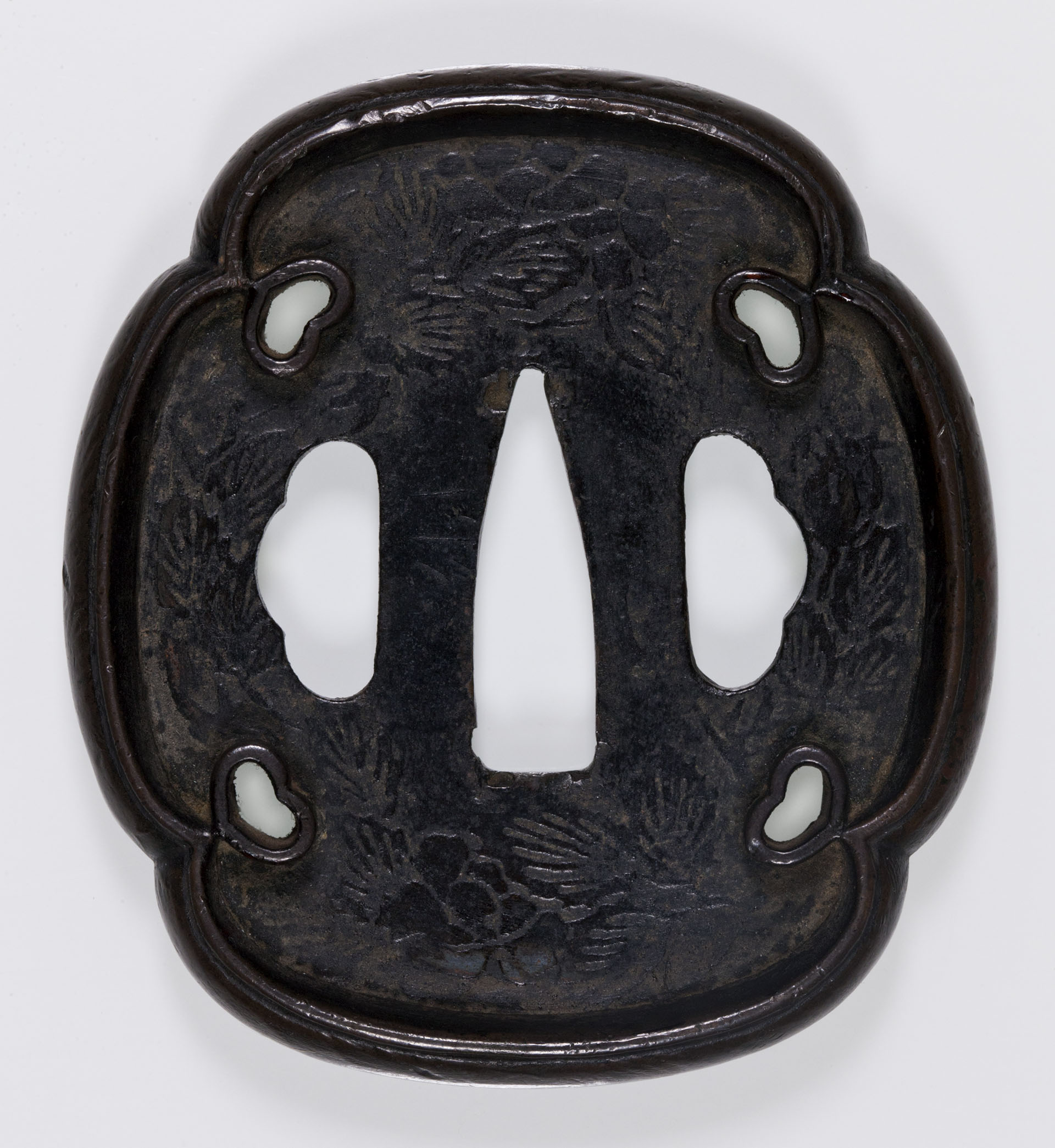
Another early soft metal tsuba with botan motif, with a comparatively subdued execution in kusarakashi .
7.35 cm H x 0.95 cm T mimi, 0.22 cm T seppa daiThe other side, with inome sukashi
This tsuba is published in several places, but most are not in color.
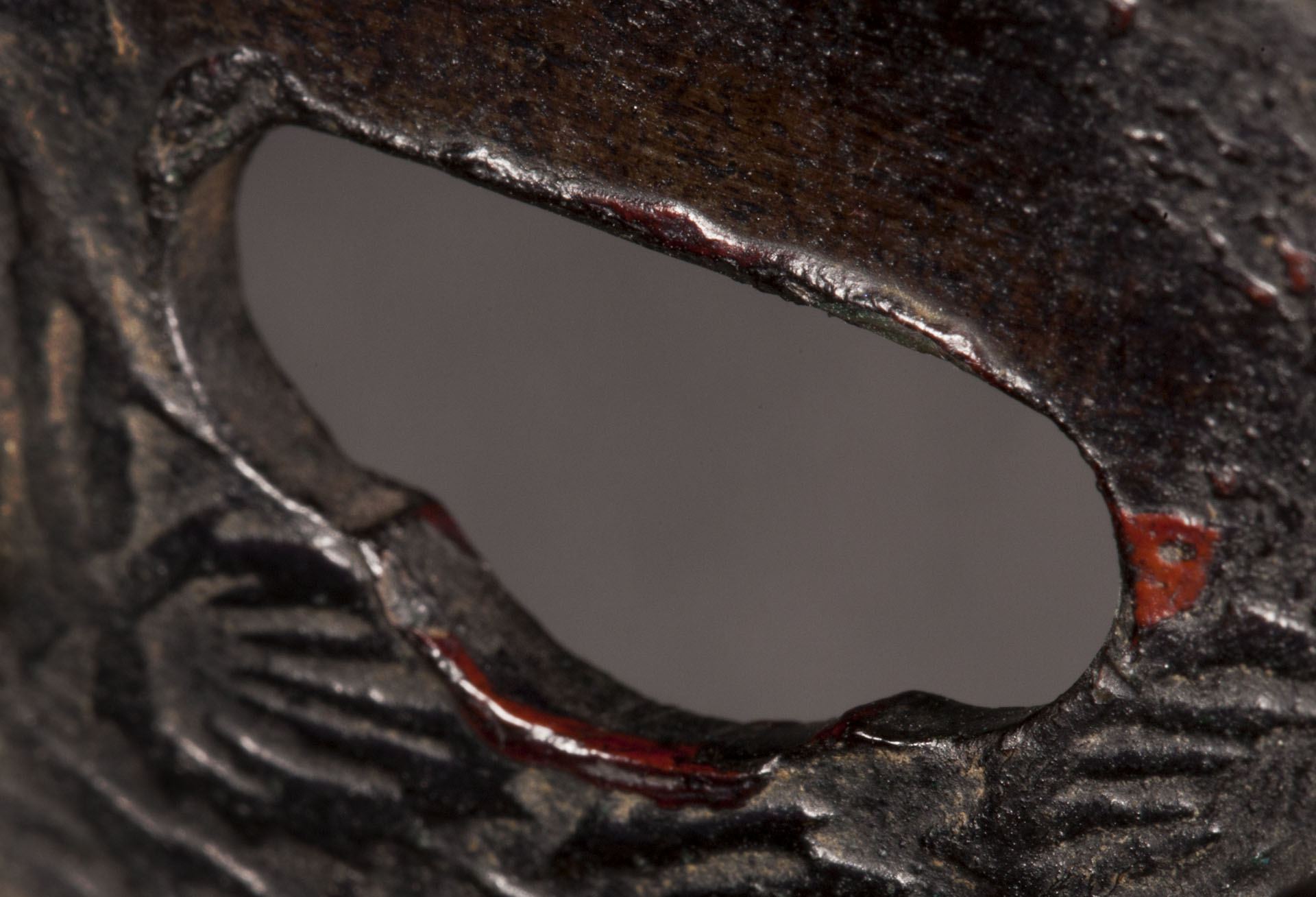
Traces of red lacquer are visible in several spots around the guard.
In b&w photos it looks like there could be a raised edge around this opening, but in a closer look it appears to be lacquer and maybe a bit of pitch rather than part of the plate. Perhaps it was plugged at some point.
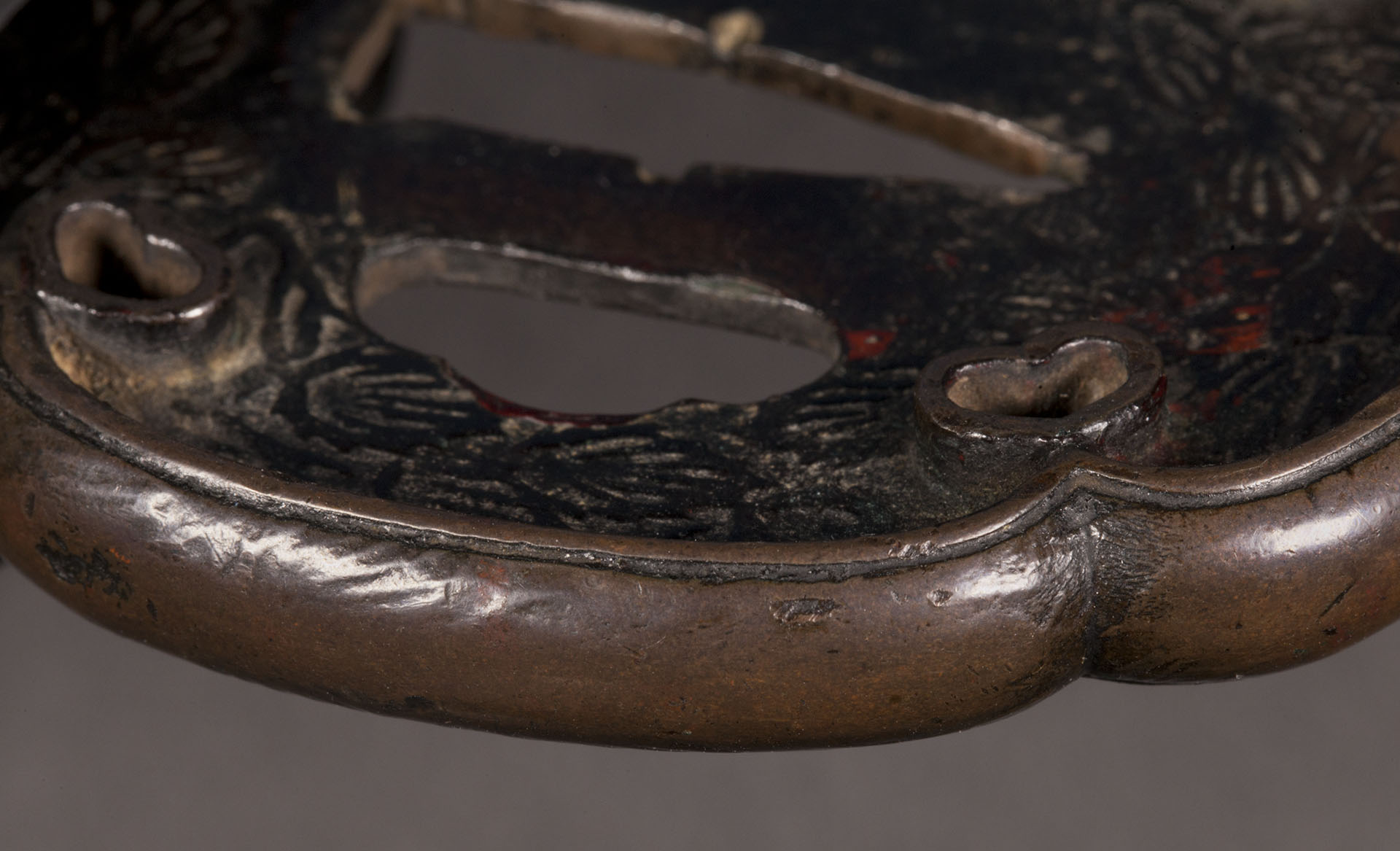
Some of the original decoration of the rim is visible here.
And here.
The similar example from the Kurokawa institute collection below appears to have the rim decoration entirely intact:
This guard formerly in the Lundgren collection shows another variation.
This one also appears to have irregular raised borders around the hitsuana. A monochrome view of the same guard here from Dr. Torigoye’s Toso Soran:
Also a different name describing the motif.
Another variation, also with what may be raised borders around the ana.
The inner wall of the rim appears to have a bit of a bevel to it, but otherwise quite similar to all of the above. One ana is filled and the other enlarged a bit into the seppa dai.
Lastly the one we started off with in black and white, also from the Kenzan Taikan.
There are many other variations on mokko gata tachi tsuba with inome sukashi, quite a few of which still have o-seppa associated with them, others have lost them but the decoration of the plate follows an outline that makes it clear that they were originally present. I don’t see any wear pattern or design of the decoration that suggests that they were ever present on the above guards.
These were all the examples of this style of construction with very thick rim and “pipe collars” around the inome sukashi style that I found in my library. It’s interesting that if they are tachi guards that were later modified for uchigatana use they all received the same style of hitsuana.
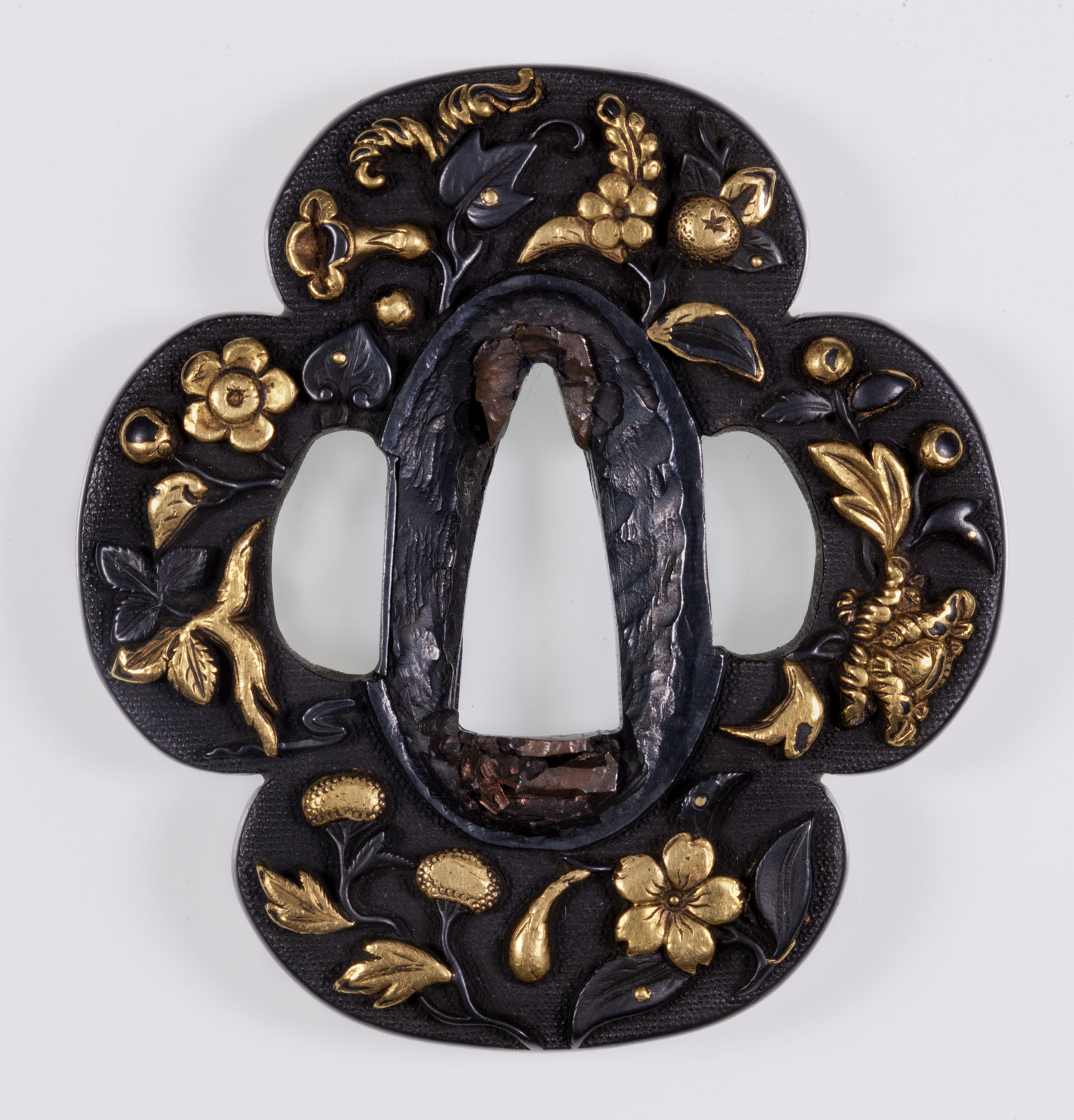
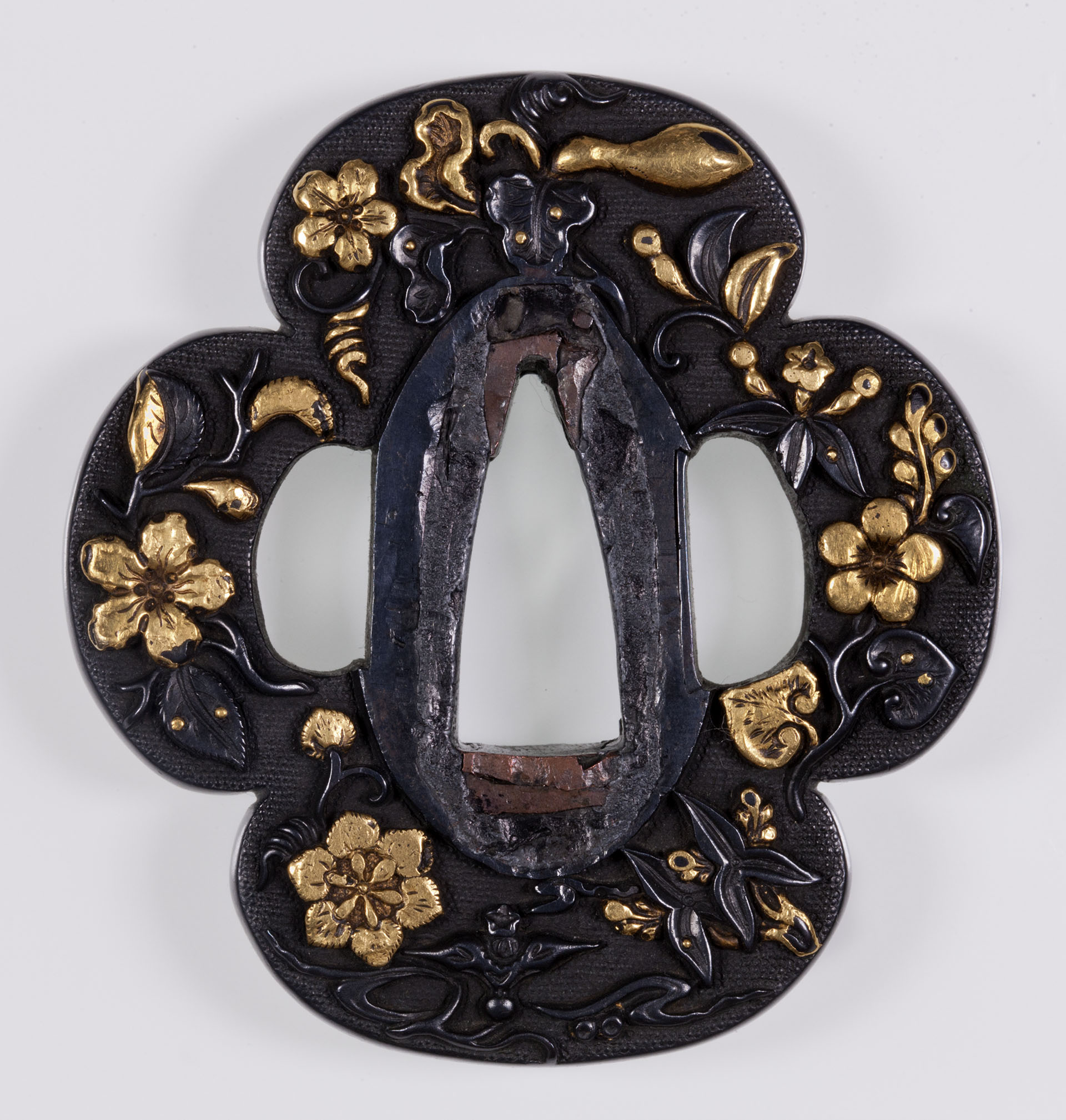
Continuing the micro-theme of early and opulent, this time in shakudo nanako with uttori zogan. This guard is rather small, but extremely thick and obviously was mounted on a robust blade.
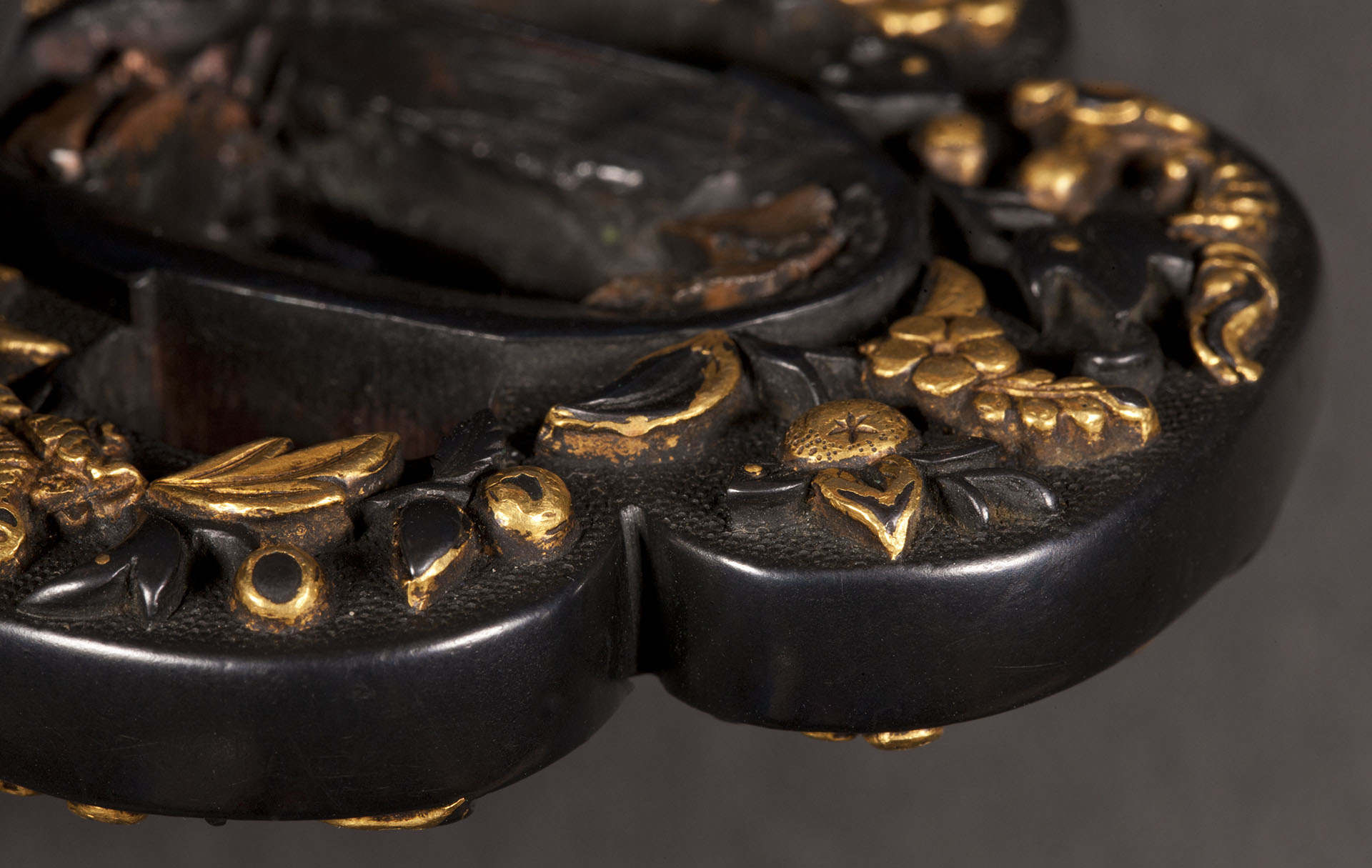
6.46 cm H x 1.07 cm TThe reverseAgain- over 1 cm thick with an undecorated rim. No sign it has been cut down or mounted with a fukurin.
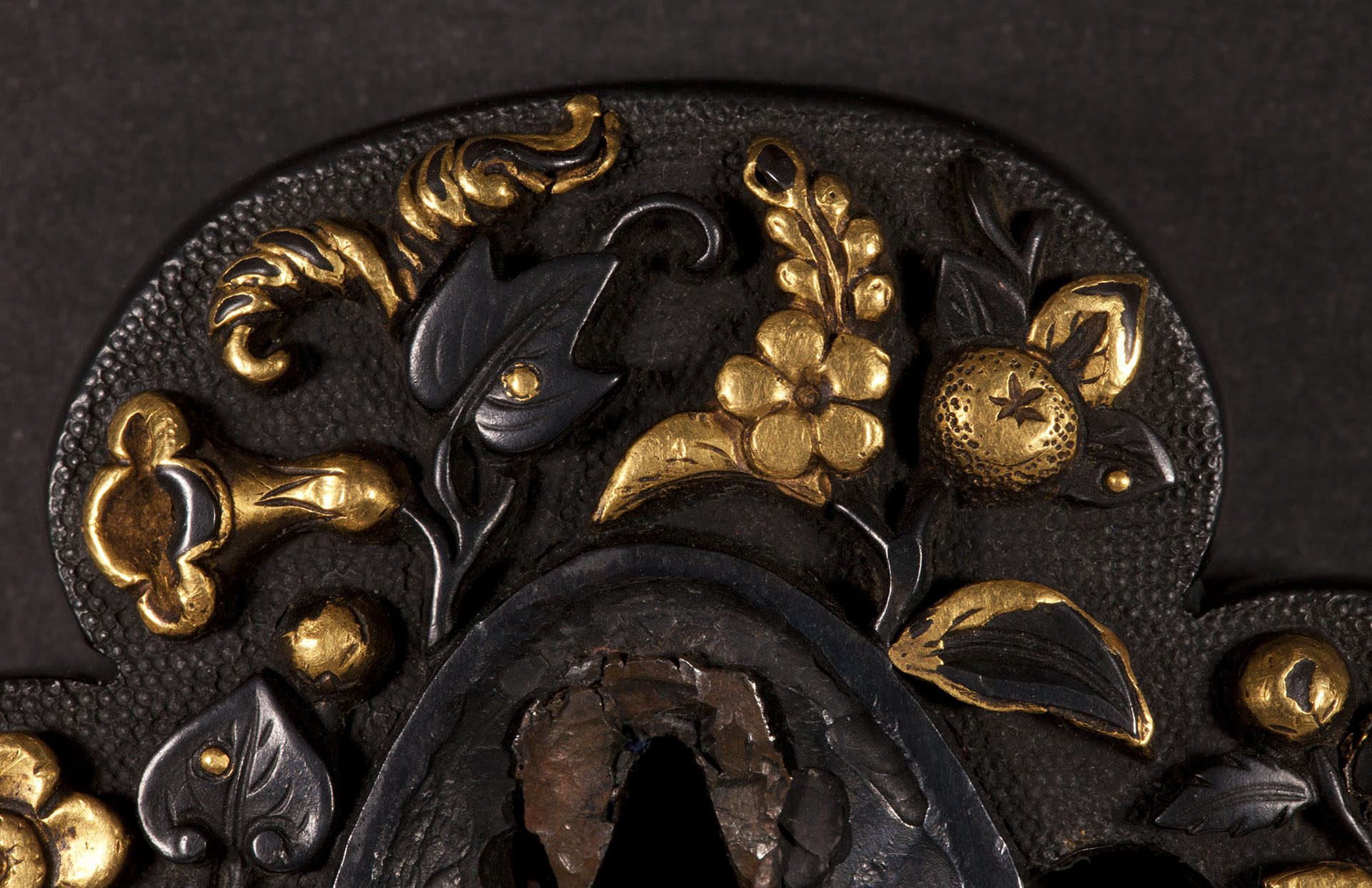
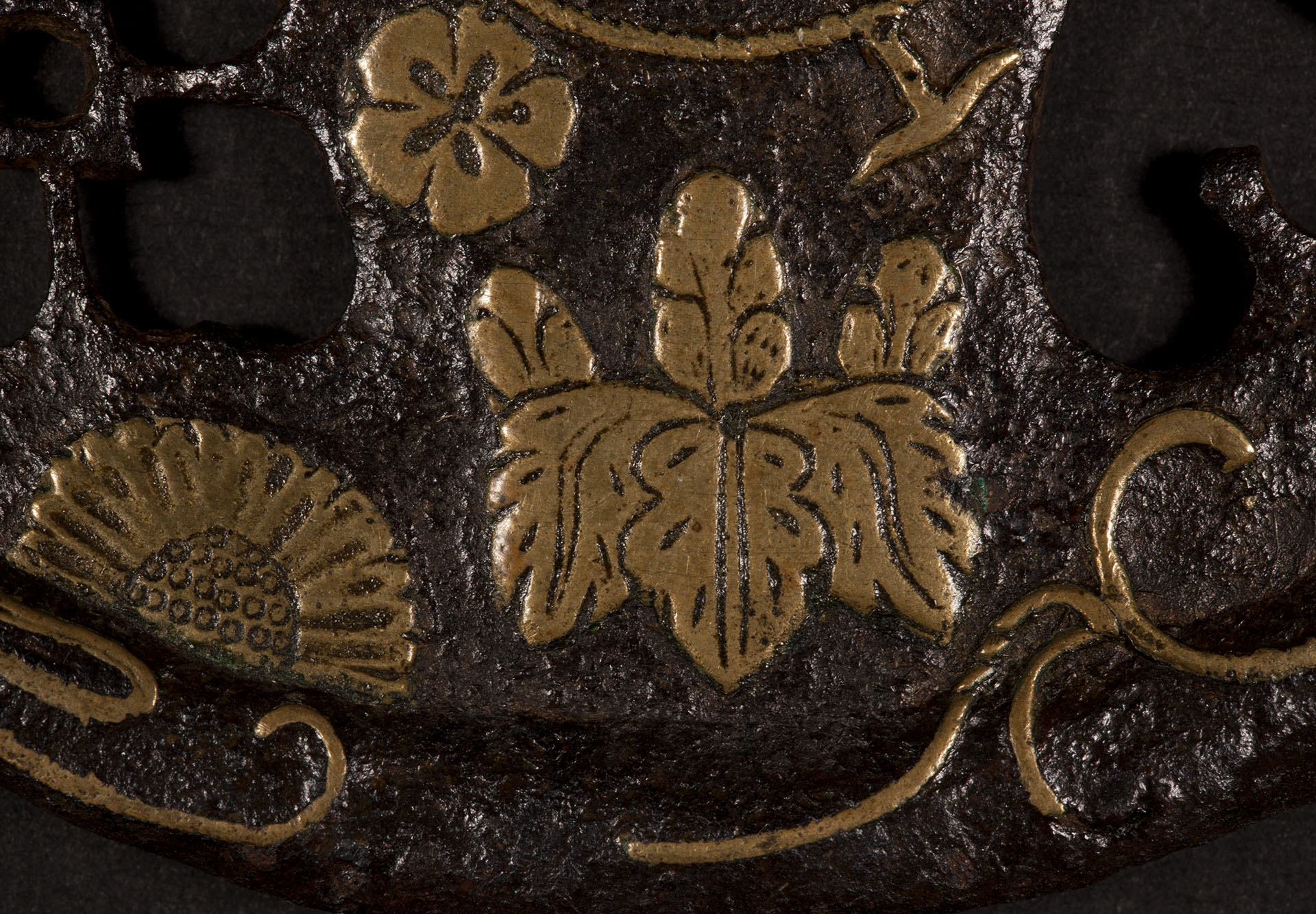
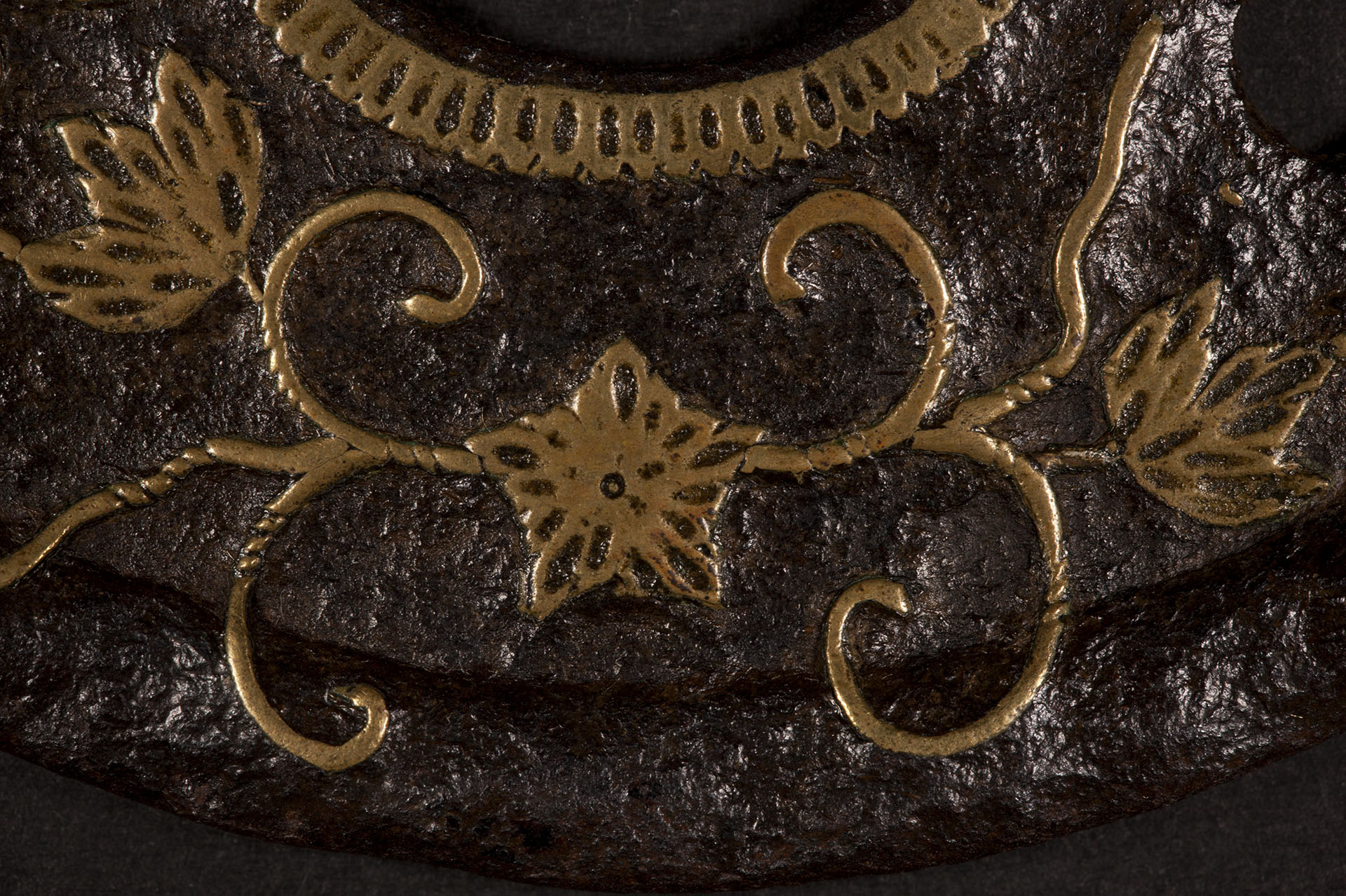
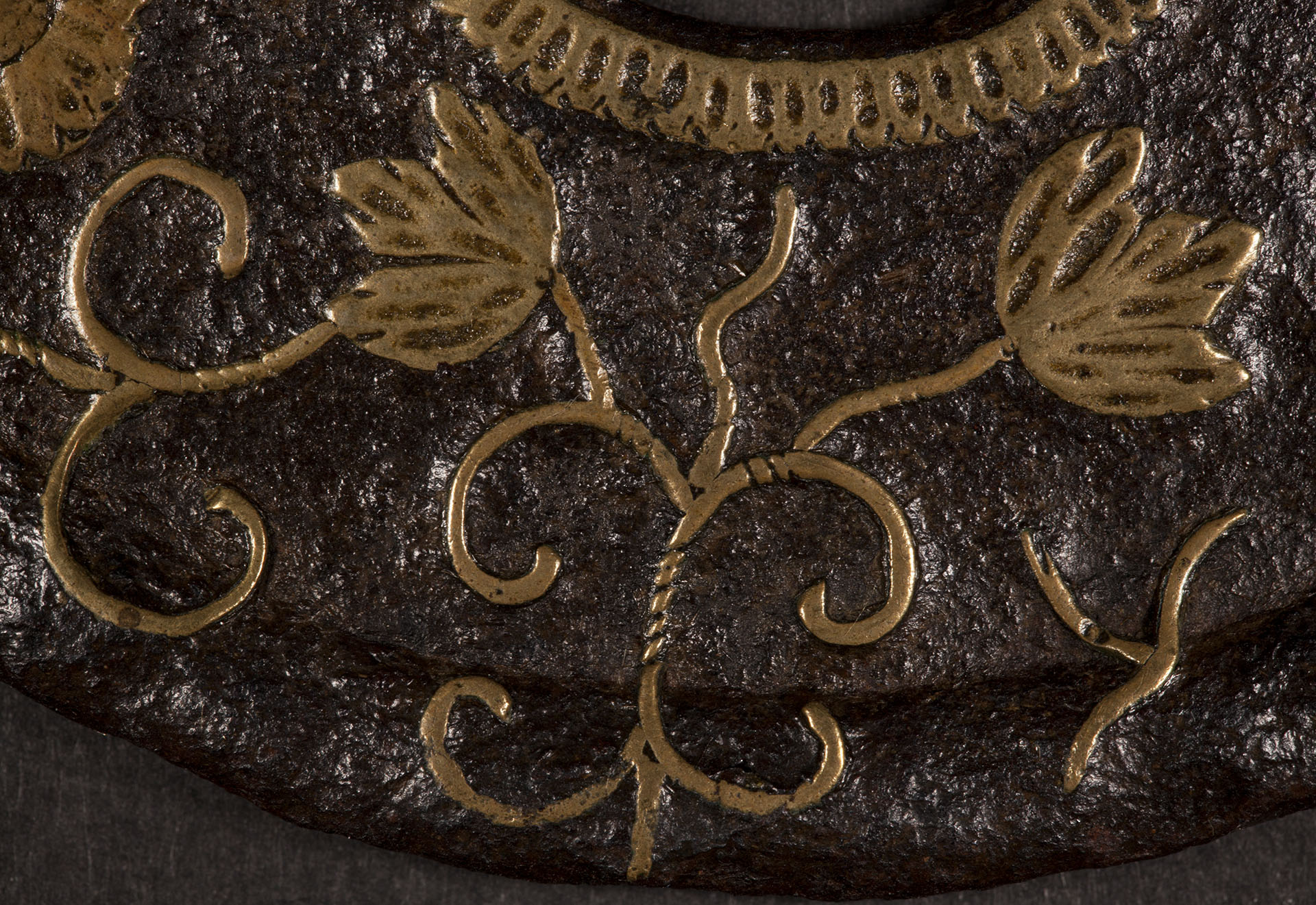
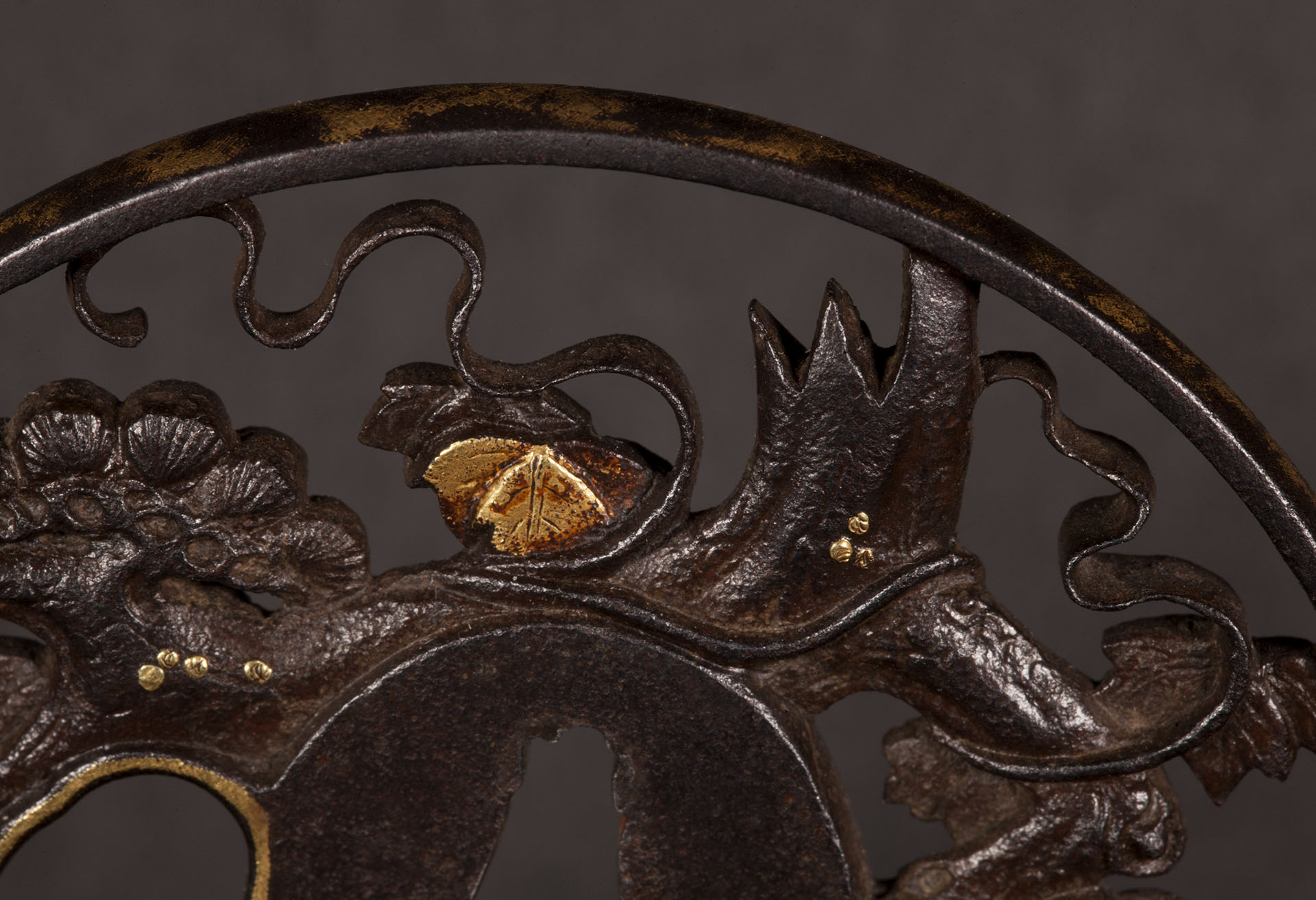
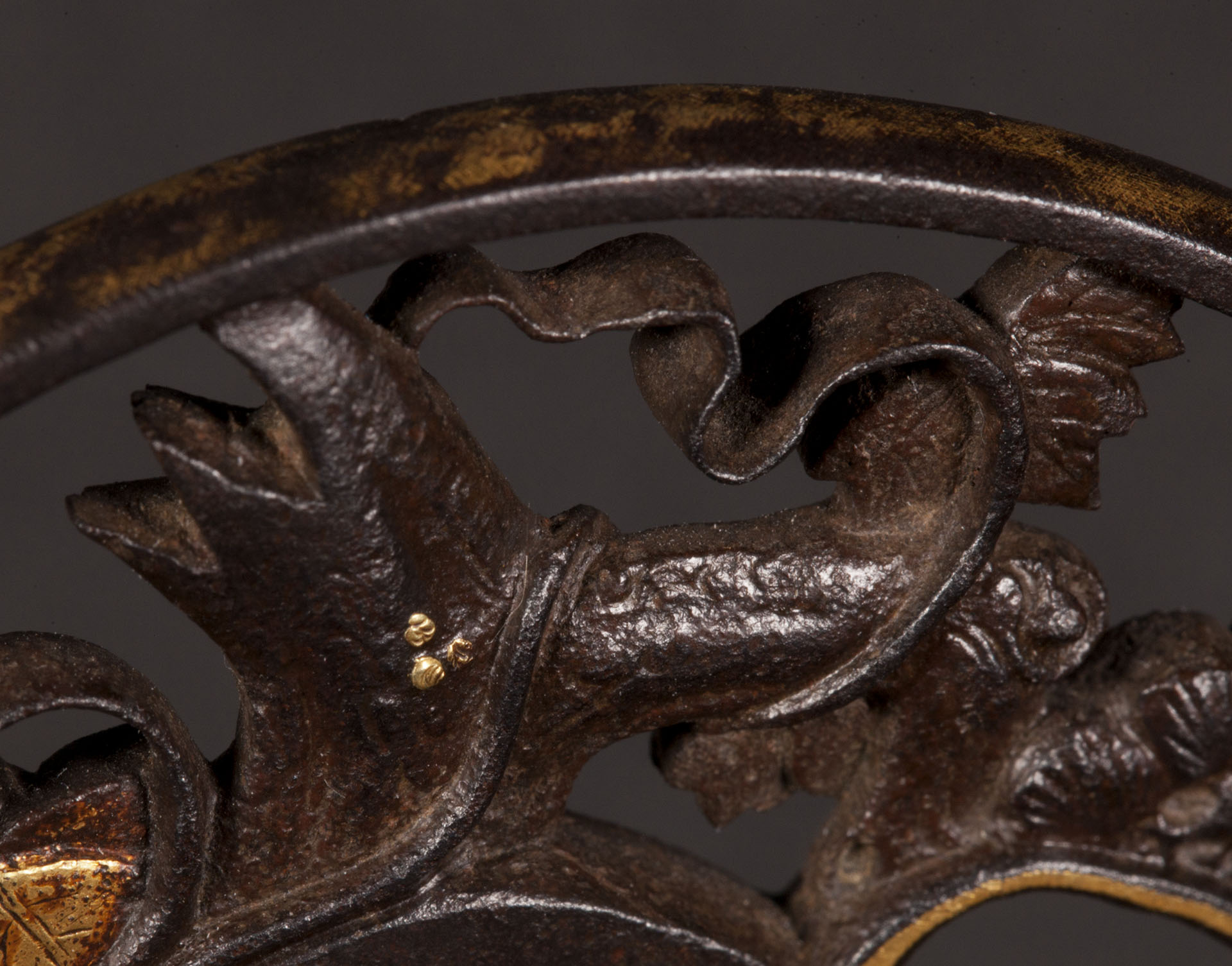
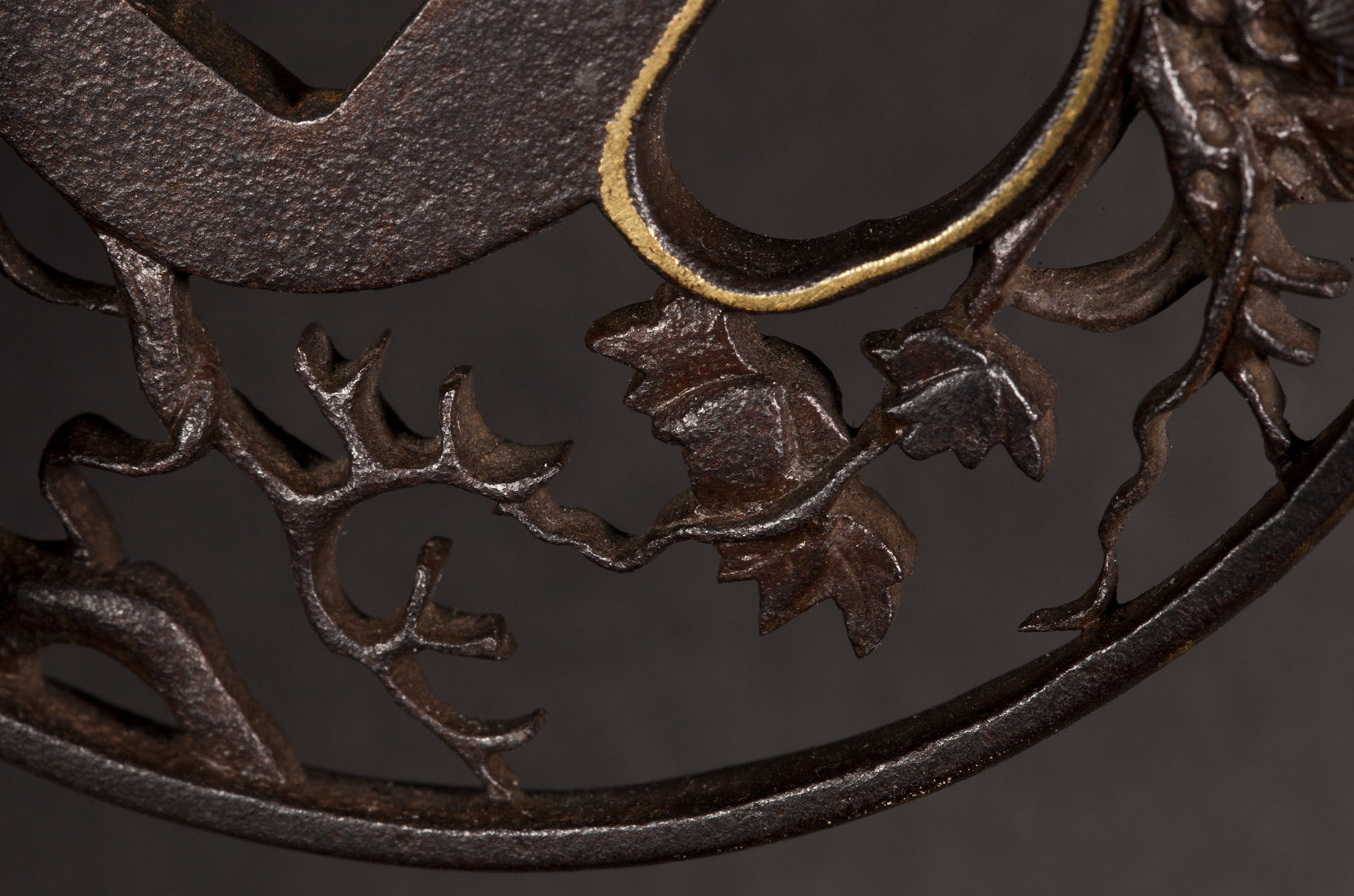
Detail views of some of the plant motifs. Usually flowers are shown realistically but leaves, stems, seeds, etc. are often omitted or substituted by generalized karakusa type motifs. Here each plant is represented fully and accurately.
Omodaka (arrowhead) at right and Hishi (Eurasian water caltrop) in center – water plants in the water. Yamabuki on the left (Japanese Keria var. picta)Asago (morning glory) at left and Tachibana (citrus) at rightOnce again, that botan (peony) motif in a different technique
It would be interesting to know what this was mounted on. Was it this thick for weight alone, for aesthetics and/or conspicuous consumption (it’s solid shakudo)? A published description speculates that it may have been a tachi guard converted for koshigatana or uchigatana use, but if so in its original state all of the floral motifs would be growing upside down and the water would be in the sky.
The small size, thickness and shape do recall some early tachi guards, and while I don’t think it was one, there may have been some allusion there. Was it mounted on a koshigatana that was worn paired with a tachi?
In any event, a good opportunity to study some of the better early Muromachi period nanako and uttori work on a guard that has it all turned up to 11.
Update: A reader mentioned that it may be that the guard was mounted on a tachi or kodachi in the present orientation. Given the large sekigane and heavy work on the seppa dai it is possible that the original nakago ana pointed the other way and that its original outline was lost in later remounting on a much thicker blade. If it originally had no hitsuana, it is very fortunate that none of the original decoration was cut in half when they were added.
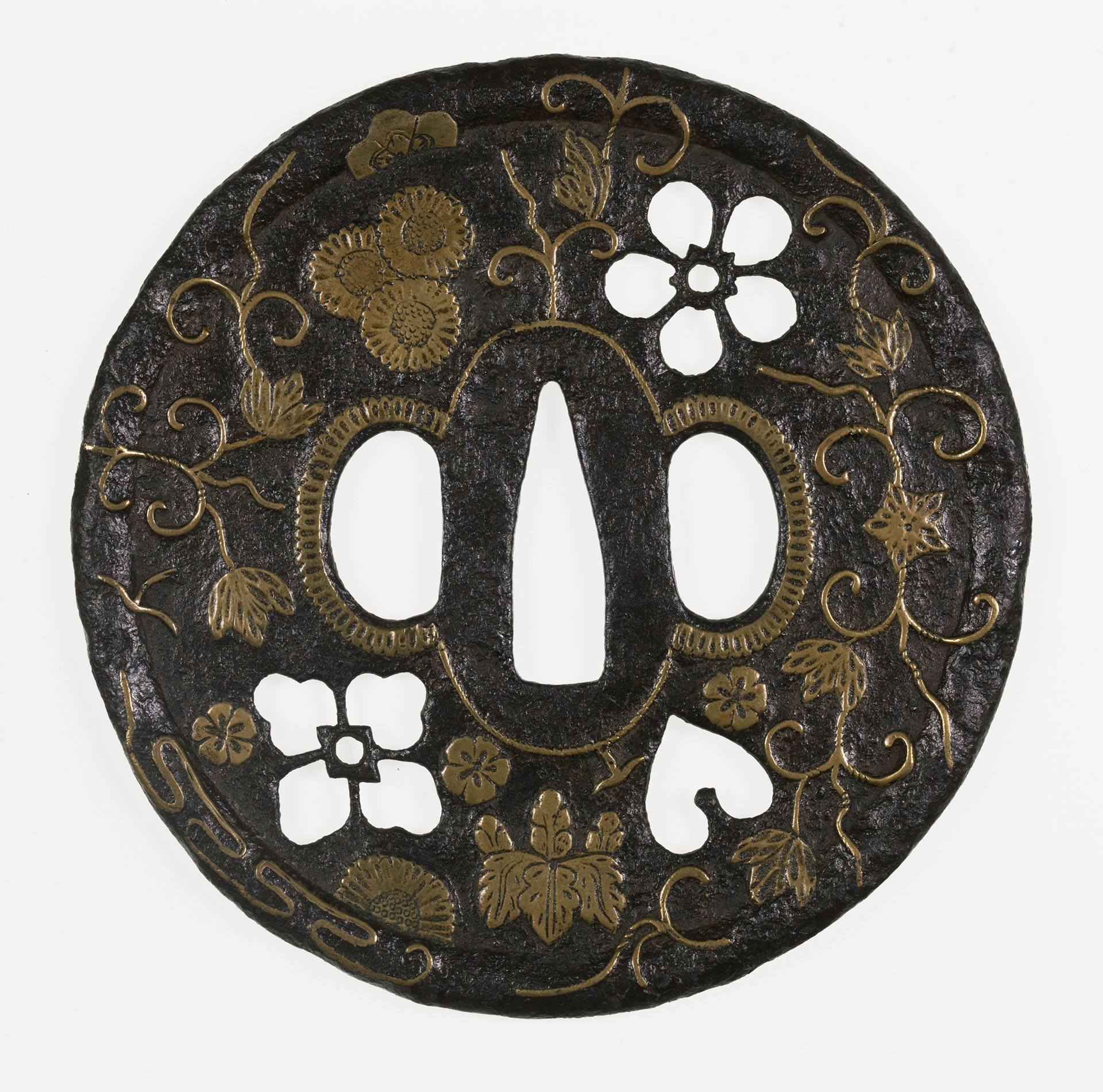
Here’s another Onin tsuba for comparison to the one in the previous post.
9.91 cm H x 0.42 cm T mimi, 0.18 cm T seppa dai
Large, thin and unusually intact, it’s one of the nicer ones to have survived. Clearly the hitsuana are original. Without inlay, it would be a good ko-katchushi guard with ume, hanabishi and inome sukashi.
Occasionally some styles of early iron tsuba are found in versions with no inlay, with hira zogan or with nunome zogan that would be attributed to Tosho/Katchushi, Heianjo and Ko-Shoami respectively. It seems unlikely that these were actually the work of different “schools” but were various options available on the base model. I’ve wondered if all of the work was done “in house” on these, or if the inlay work was subcontracted out to an specialist.
In any event, the customer opted for maximum opulence in this case.
The plate surrounding the kiri mon and kiku shows the clearest signs of having been worked to hold the shinchu suemon inlay in place.
The kiku here, particularly on the lower left show some brass exposed outside of the design that wasn’t buried under the iron. It’s not as pronounced as in the previous example with the botan inlay. I’m not sure it’s quite the same thing. Also interesting is how the brass tendrils are fitted together – definitely not obvious without magnification.
The kiri mon on the back side shows a little more “flange” to it. Perhaps not quite as carefully done as the front.
Given how often brass inlay tsuba from the Edo period are missing pieces it’s remarkable that one this old was worked carefully enough to hold on to even the thinnest elements. In guards with some losses it’s usually possible to see the undercutting of the iron plate done around the edge of the missing inlay to hold it in place. I’ll keep an eye out for one to photograph.
Another tsuba from the Chicago show is one that I’ve admired from my earliest collecting days. It appears in the second Haynes auction catalog from 1982 (about ten years before my time, with tsuba anyway).
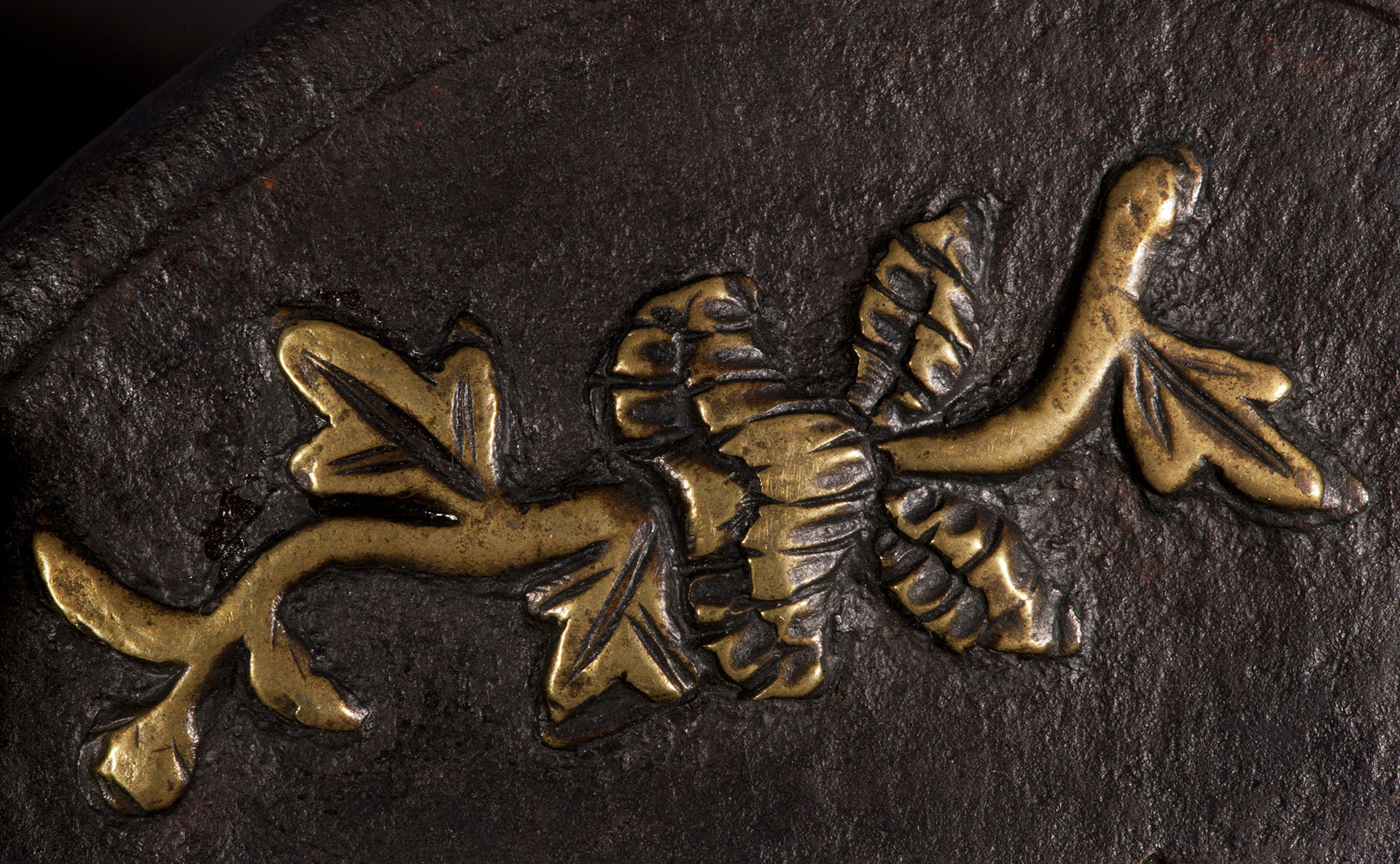
8.42 cm H x 0.38 cm T Botan motif, shinchu suemon zogan
Lot 2, from the catalog: “Very rare and important Onin example”
“Iron rounded aori shape with raised carved rim, to resemble a rim cover, with good iron bones in the edge. The plate is inlaid on both sides with four peony branches of cast and carved brass, the edges secured by working the iron plate over the cast flange. The brass is the classical very rich color of the Onin period, circa 1450. The inlay is intact on both sides, but some of the flanges have pulled away from the plate. Ht. 8.4 cm., Th. 3 mm. (Note: it is rare and fortunate that riohitsu were never added at a later date.) (Est. price 500-750)
Ex. Jack Paras sale, lot 2, May 26, 1981″
Here’s a closer look at the inlay. The exposed flanges are particularly visible on the far right leaf and the bottom middle one.
I’ll have to make a closer inspection of other Onin guards to see if that is present but just not as obvious. There are some other places where the inlay is slightly lifted as Bob mentions, but here it appears tight to the plate and was probably never covered. The rest of the surrounding iron does show signs of being moved over the brass. Obviously enough was done to hold the inlay in place.
There are similar guards published, but not with enough detail visible to say for sure, but I don’t see that here.
Shishi Botan from Hyaku TanShishi Botan on copper alloy ground. Source unrecorded
Many thanks to S for sending it my way after keeping it carefully for all these years.
I came across an interesting tsuba at the Chicago show last weekend. It’s nicely made and has an unusual texture to the iron. Design-wise it’s hard to say to who and where it might belong. It would very likely draw a Shoami attribution at shinsa if uninscribed, and I can’t see how this inscription would change that.
8.38 cm H x 0.49 cm T, suhama mon on left and matsukawabishi mon on right with ken, possibly enclosed within sacred jewels
The rim has a bit of activity to it, although it’s not quite tekkotsu. There is some texture and reflective patches. The guard has a pretty high pitched ring to it for its size.
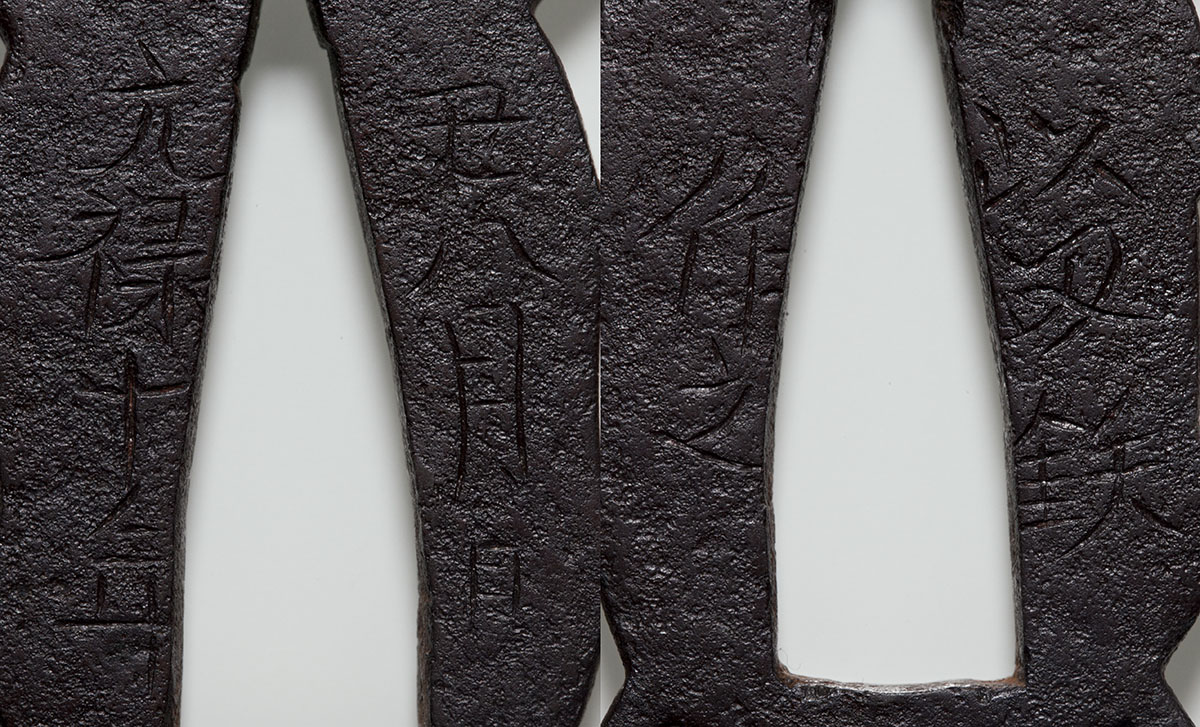
We have few dated iron ji sukashi guards, so that is the first thing that makes this one interesting: Genroku junen ushi hachigatsu hi. 8th month of 1697.
Date left, non-signature right
So, the other side “should” be signed, but it isn’t. It seems to say “ha tetsu o mote kore o tsukuru.” The middle kanji on the right is the tough one. The rest is pretty standard, but it’s hard to say if that is “ha,” and if it isn’t then what is it? Any ideas?
If that is what it says, it’d be “made of cutting edge iron.” Notations about the type of steel are seen in sword signatures occasionally, but this one would be redundant on a blade. On a tsuba it makes me wonder if this was the work of a swordsmith or a tsubako. Edo tosho tsuba are well known, but they’re usually relatively simple.
If this was the work of a professional tsuba maker then why isn’t it signed? There’s room for it. Is it possible that this guard was delivered with a newly made sword, so date and material were worth noting, but signing the tsuba would be repetitious or unimportant? If the former, it was especially meticulously made by the swordsmith, if the latter it was subcontracted out to a tsubako who didn’t get to put his name on his work. In either case I’m guessing it was made from metal reserved from forging the blade.
The tsuba doesn’t appear to ever have had sekigane and the only signs of adjustment are two tiny strikes at the top front side of the nakago ana. So probably fitted to a sword, but only once. Maybe made for a sword. One with a fairly large nakago. It’s not exactly in the height of Genroku period fashion, so who knows if it was used at all.
As usual, more questions than answers. Thanks to G&N R for helpful consultation.
Last updated 2005 – seems like yesterday… no it doesn’t.
Recently I’ve heard a time or twenty that my old tsuba site is offline. Back in the mid ’90’s there was a thing called a “personal home page” that came for “free” with your dial-up account. For better or worse, that’s where the ancient technology behind Tsuba has been creaking on for all these years. If there was too much traffic the site would be shut down until the meter ticked over again at the start of the month and it would be restored. It turns out that a month ago the meter was turned off for good. I got no warning at all that the legacy sites were going to be shut down. Others got a few days notice to save anything before it was gone forever. I think there were probably about five of us left.
So, it’s gone and it is not coming back. It’s a coincidence that I started this blog at around the same time, but a good one. I have all of the files from the original site and may reprise some text if it still seems relevant. Some of it definitely isn’t, maybe most of it. The photos are pretty much useless other than for nostalgia since the bandwidth upon which the infrastructure was built was such that users complained bitterly about any inline image bigger than a thumbnail.
Update: I have the site running locally on my desktop now so if anyone needs an extract I can get it easily.
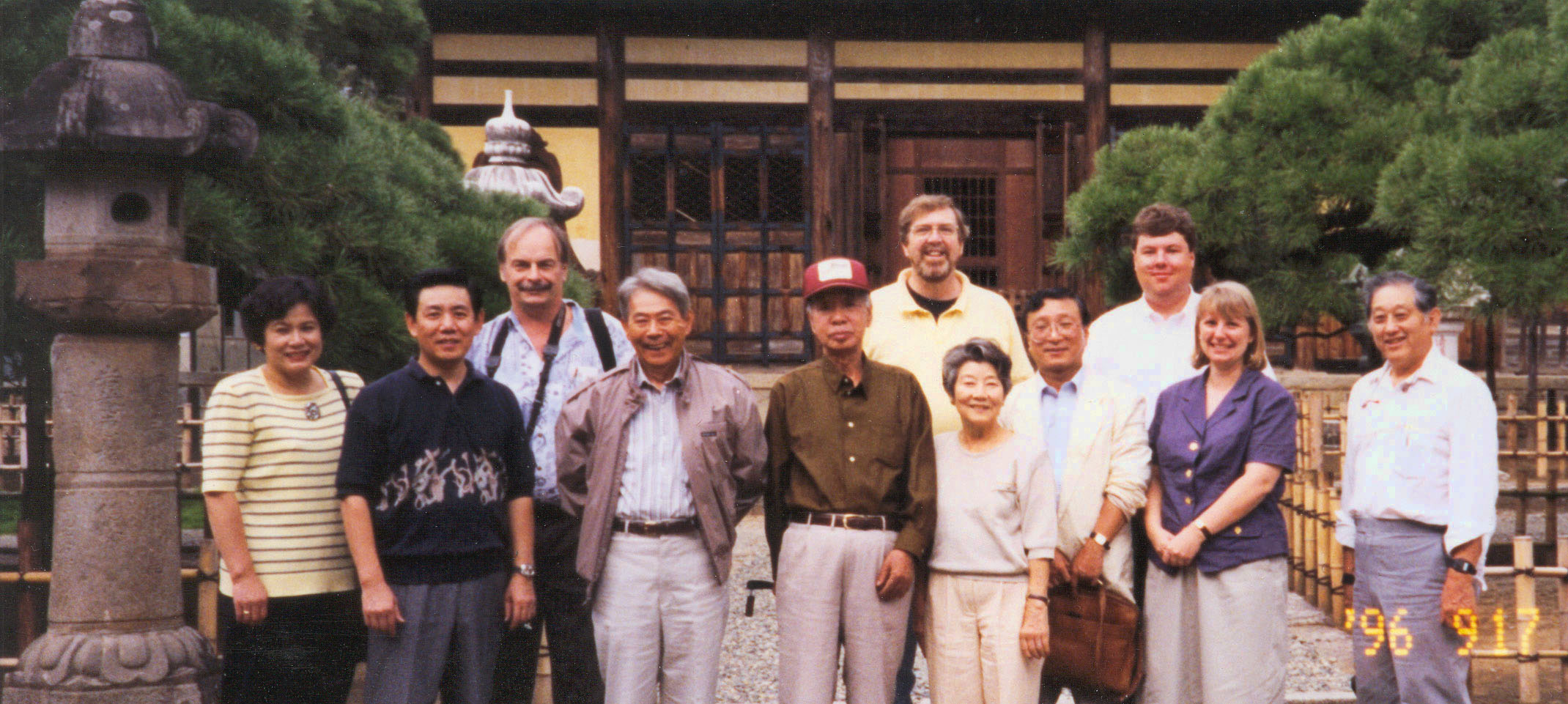
What were you doing in the sword and fittings world back in 1996?
Can you name them all?
This was taken by Yoshikawa Eichi out in Yamanashi prefecture. Starting on the left, Michiko and Mamaru Hagihara, Jim Kurasch, Min Shintaku, Yoshikawa Kentaro sensei, Gordon Robson, Mrs. Yoshikawa, Mr. Omino, Jim and Laurine Gilbert and Sam Oyama.
After thinking about tsuba finishing from the previous post, I’m adding this tsuba as an example of reaching for the limits of thinness in iron sukashi. The maker is listed in Haynes at H 07513:
NTS: G. Heckmann: TSUBA, 1995, T 39, oval iron plate carved in the round with Michikaze with large umbrella by a willow tree and a frog on the ground, with gold and silver inlay. Somewhat in the Kyoto style and with Soten overtones, signed: Nobunori. SCE. G. Heckmann, 1995
That tsuba from Heckmann is here:
It’s clearly the same guy although the work is a bit less technically extreme. I haven’t found any other examples illustrated but will keep an eye out. Kyo mixed with Soten is about right, but it clearly is his own style. I don’t imagine these were the creation of an amateur who only made a few guards.
So, a closer look at the details of the first guard.
Not only are the lines extremely thin, their width tapers as well and “all” 5 mm of depth is layered in different levels. I don’t see any filemarks (other than the nunome) under more magnification. Was there an easy way to do this? If it was made separately and inlaid or otherwise attached, I’m not seeing any signs. Amazing.
Update: I had a random thought and checked the fine tendrils with a tiny rare earth magnet to seek out possible non-ferrous shenanigans. None were found.
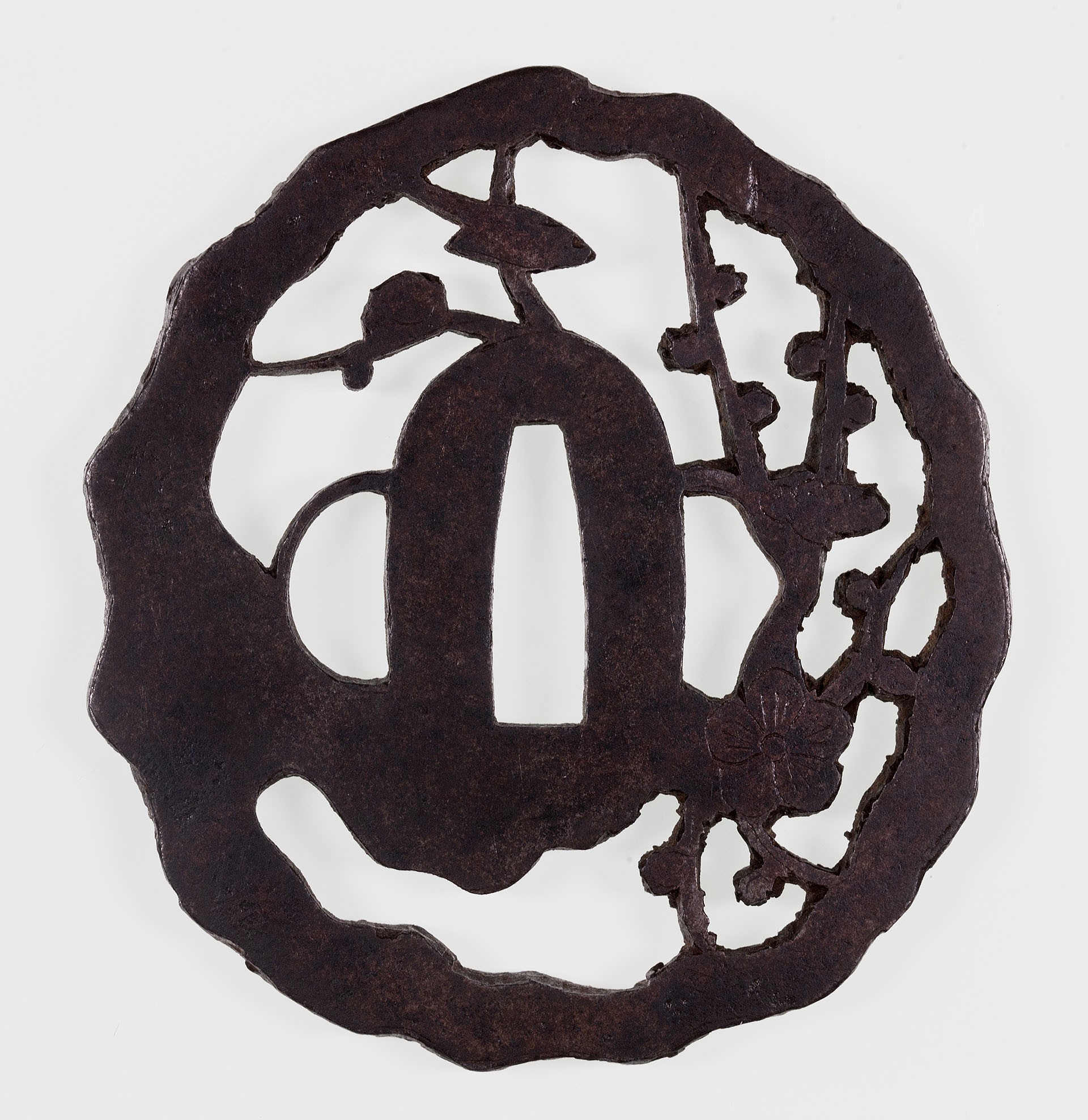
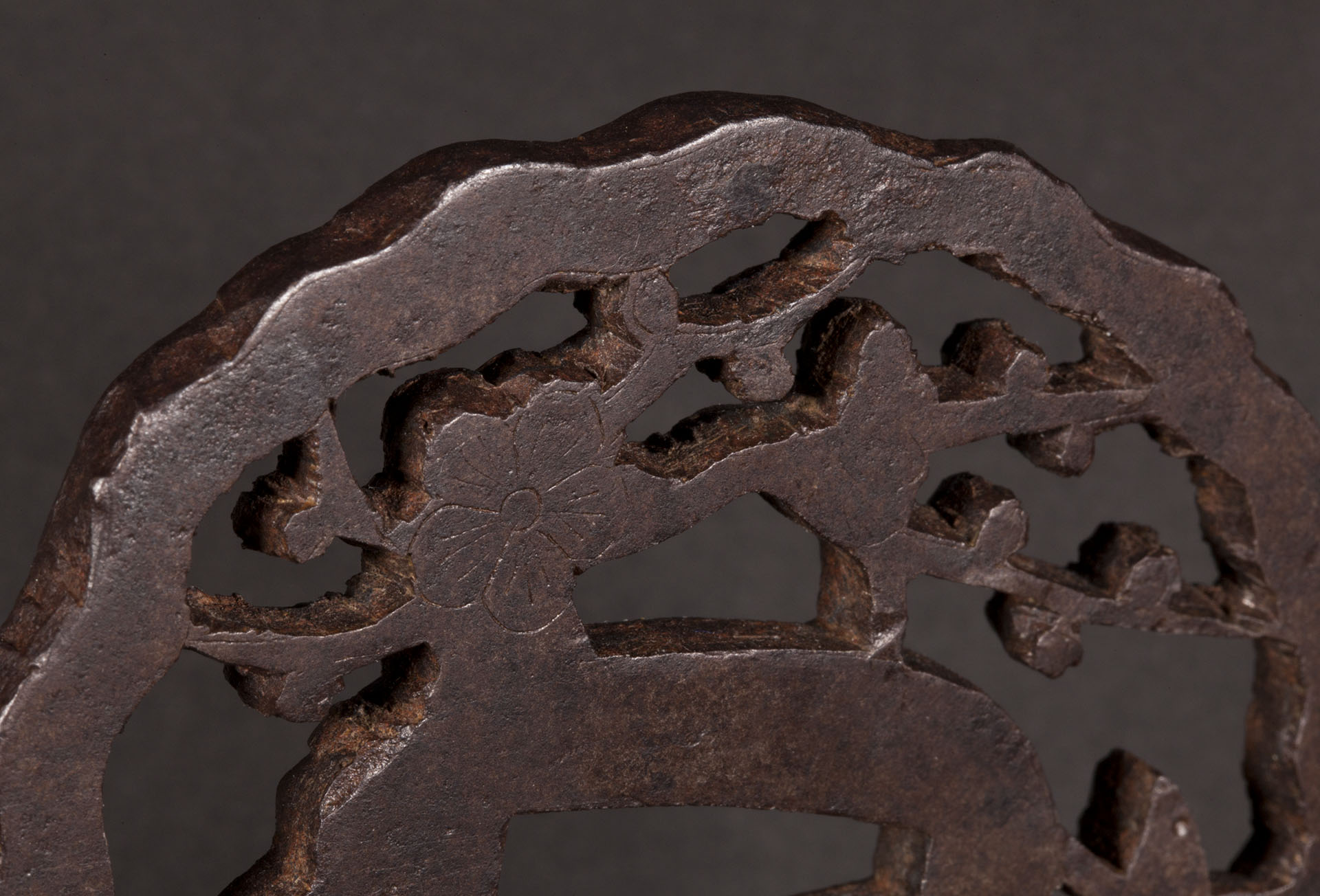
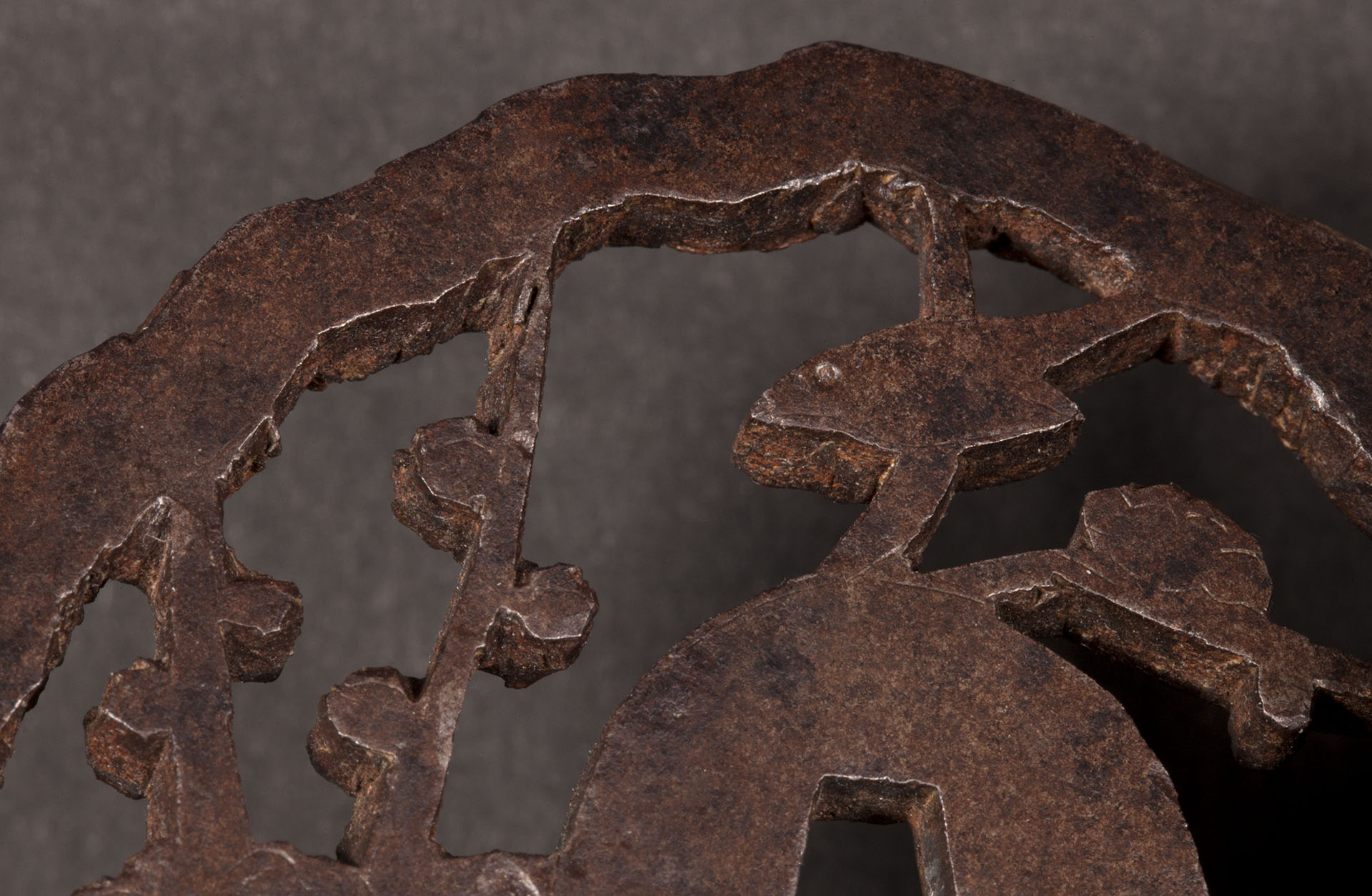
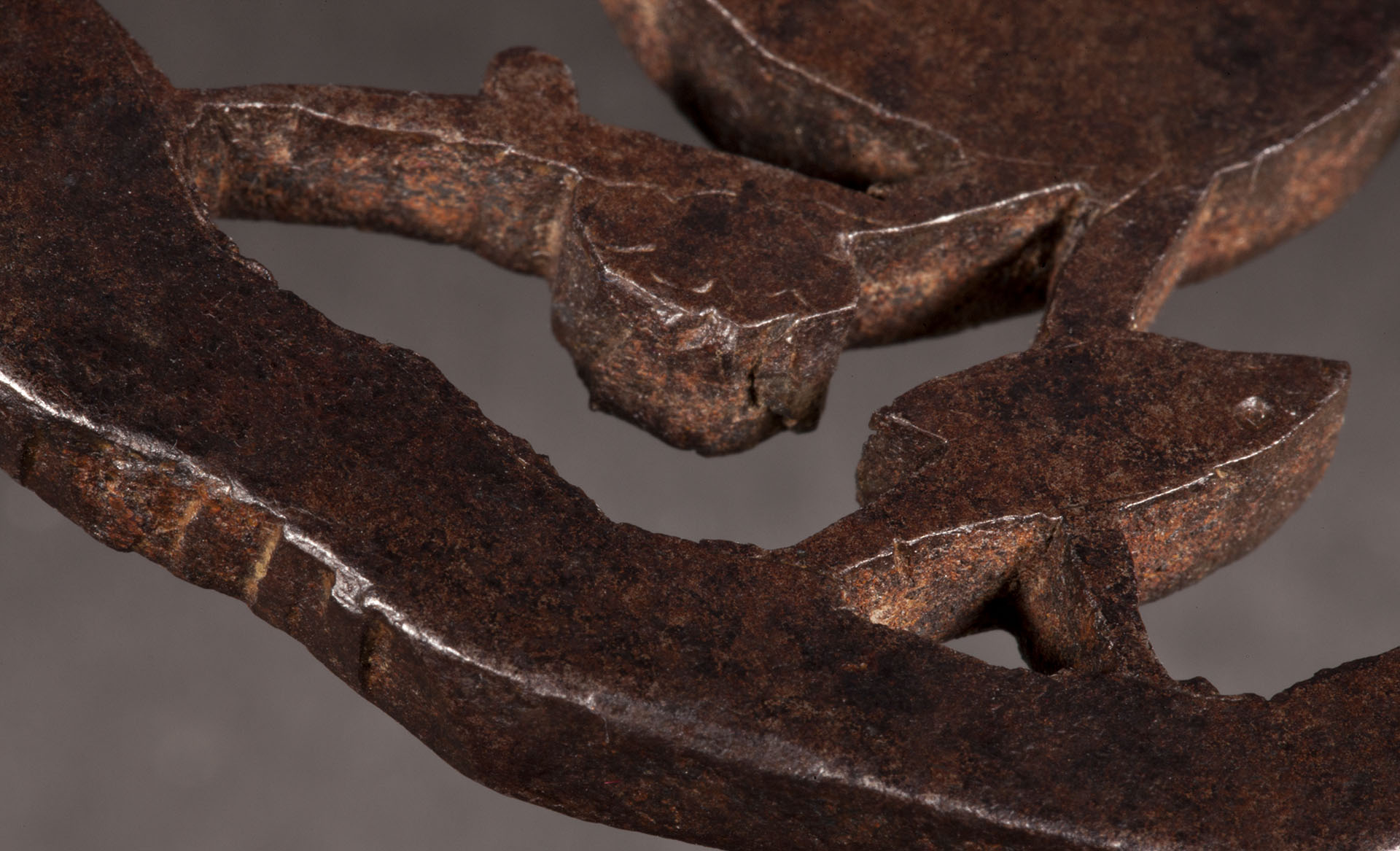
This is an Akasaka or Higo style tsuba with the plum branch and bird motif that was roughed out but never finished. Given the angles at which the hitsuana meet the seppa dai, I’d lean toward Higo, but that’s not really the point. As we’ll see below the blank was worked with a chisel.
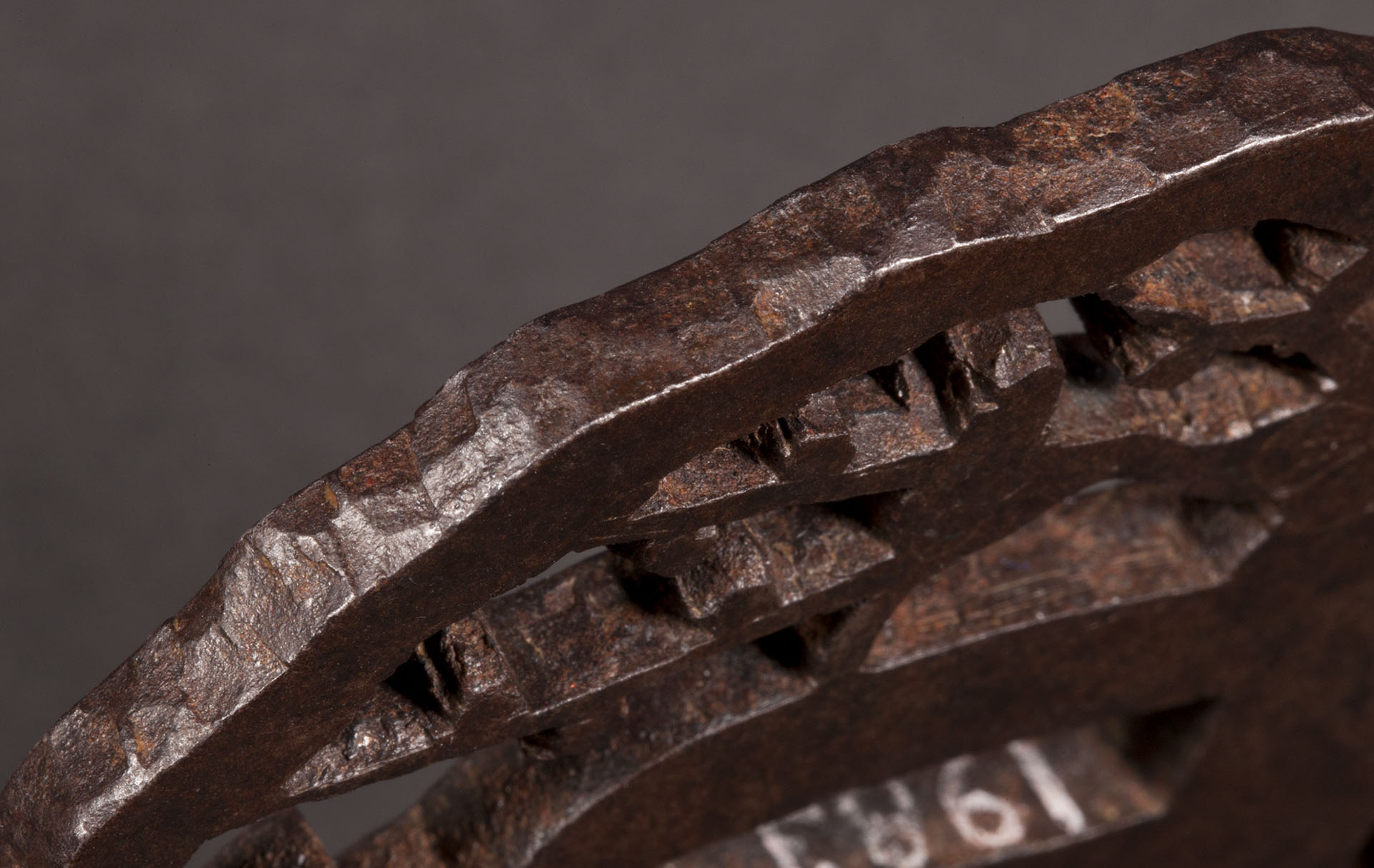
Each chisel stroke is easily seen in this part of the rim.
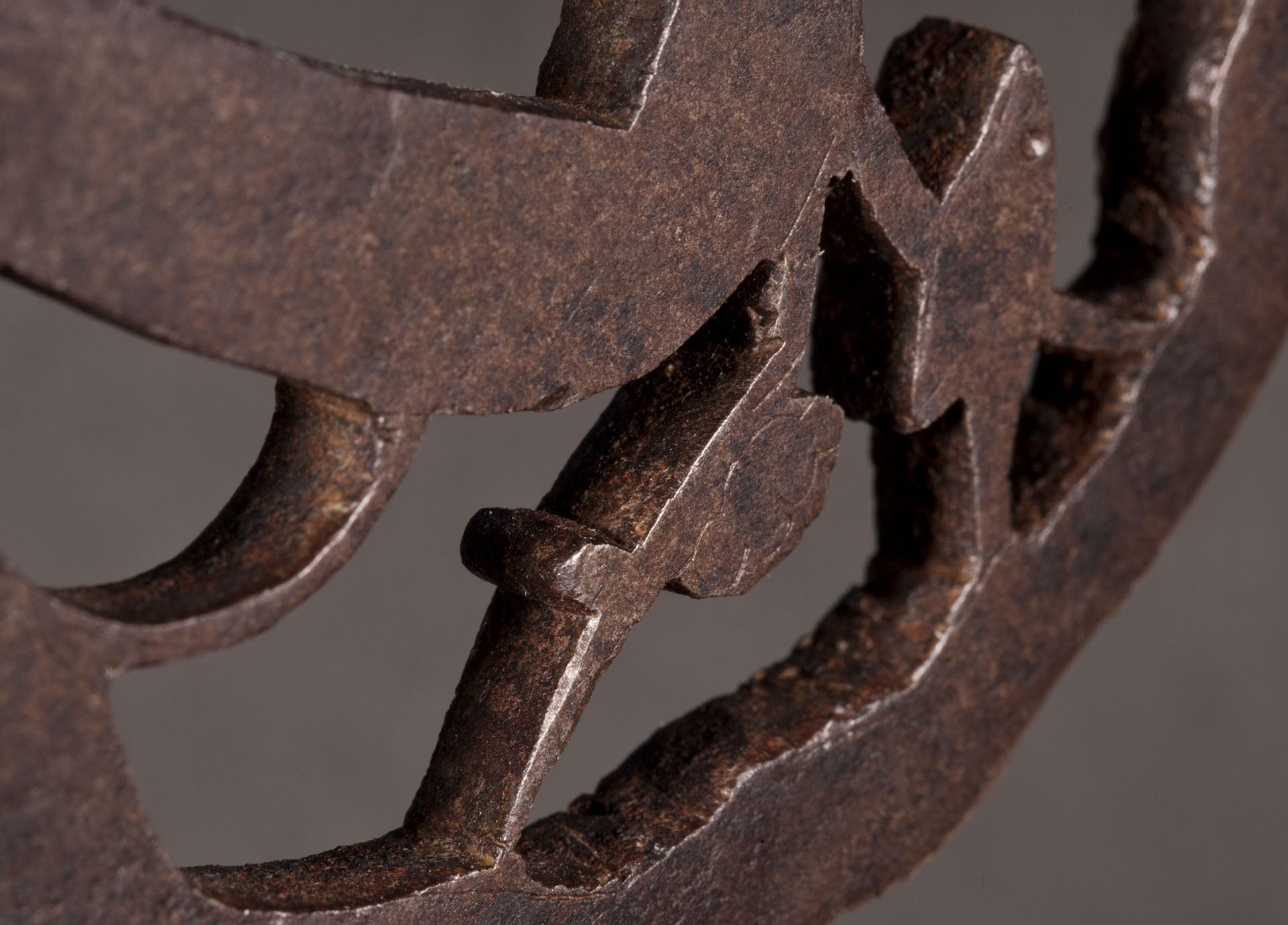
The openwork is chiselled very close to the kebori layout lines defining the shape of the rim and plum branch. Handmade files couldn’t have been inexpensive, so it probably made sense to keep their use to a minimum. Each tooth of a file required a cut with a chisel, so it was probably about as much work to make one as to cut out a tsuba like this.
Given the roughness here it looks like the maker was working quickly and confidently. Opening this up with a jeweler’s type saw would be slow work and hand made blades would probably also have been expensive. I seem to recall reading that they came into use in the Edo period, but don’t remember the source. I’ll have to look for more information. String and abrasive techniques were around well before that, but that would have meant even slower going.
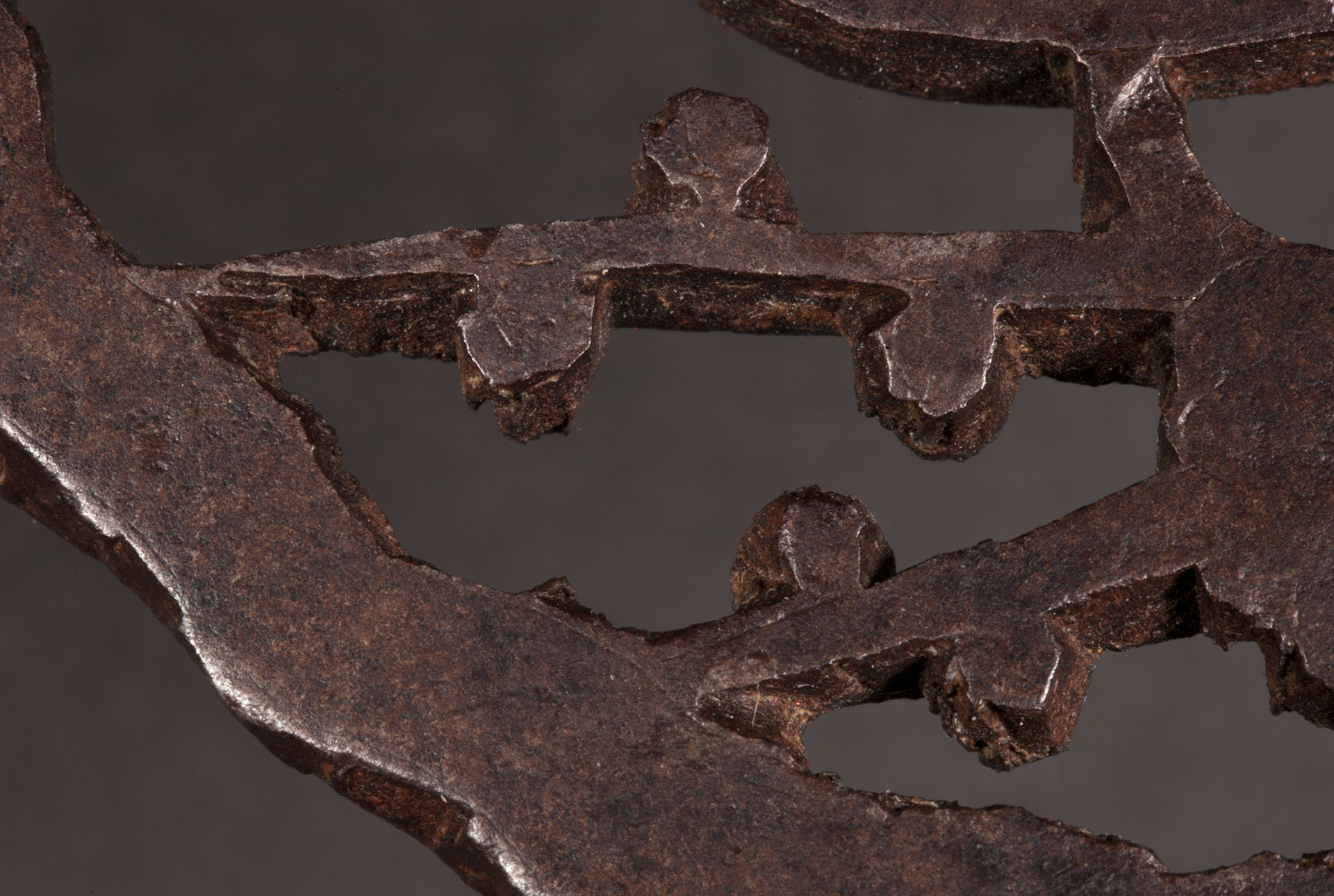
It’s possible that the tip (left) of the upper branch may be the reason the work stopped. The chisel stroke cuts over the centerline of the design. It seems like that could be closed back up without much trouble, but maybe that would be asking for headaches later in the process (or from the boss).
At the right side here there openwork has been refined beyond the rough chiselling. It looks like it may have been scraped down. Comments from metalworkers are welcomed.
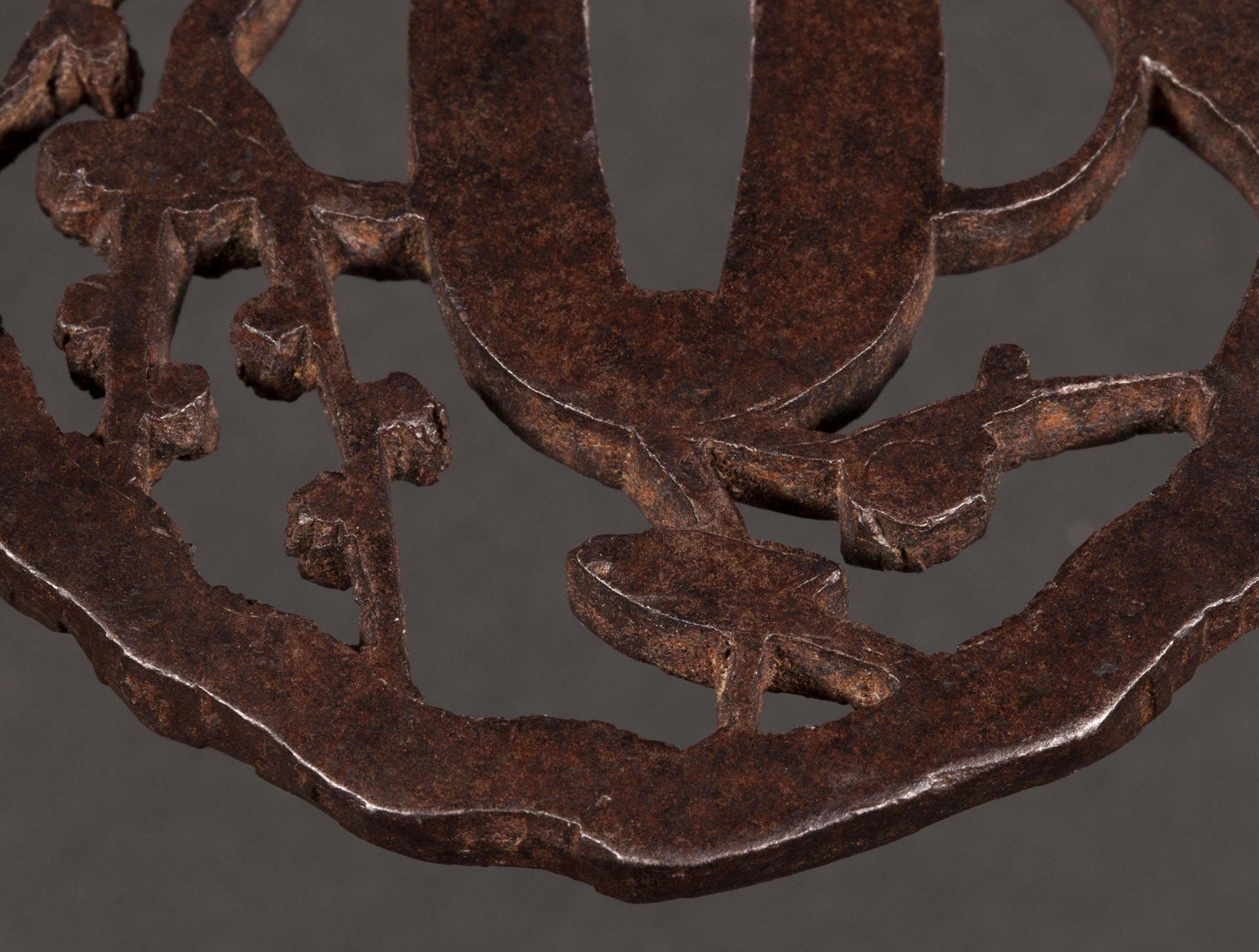
It’s interesting that work that’s quite rough is next to spots that are almost finished instead of working everything uniformly from the rough state. The nakago ana, seppa dai and hitsuana were “cast in stone” early in the process.
There are some coarse-ish apparent file marks visible in the most finished section, but they aren’t showing well with either the macro setup or microscope. I wonder if the rim was going to be finished off with a circular cross section or left flat. Interesting choice to have refined the branch tip to that point while the rim is still rough.
I found an interesting video on a likely process for making early files. It’s not about Japanese technique, but from what I’ve seen the methods were probably similar (and the production values here are better).
His whole project on recreating the antikythera mechanism with period methods is well worth checking out. Amazing stuff.
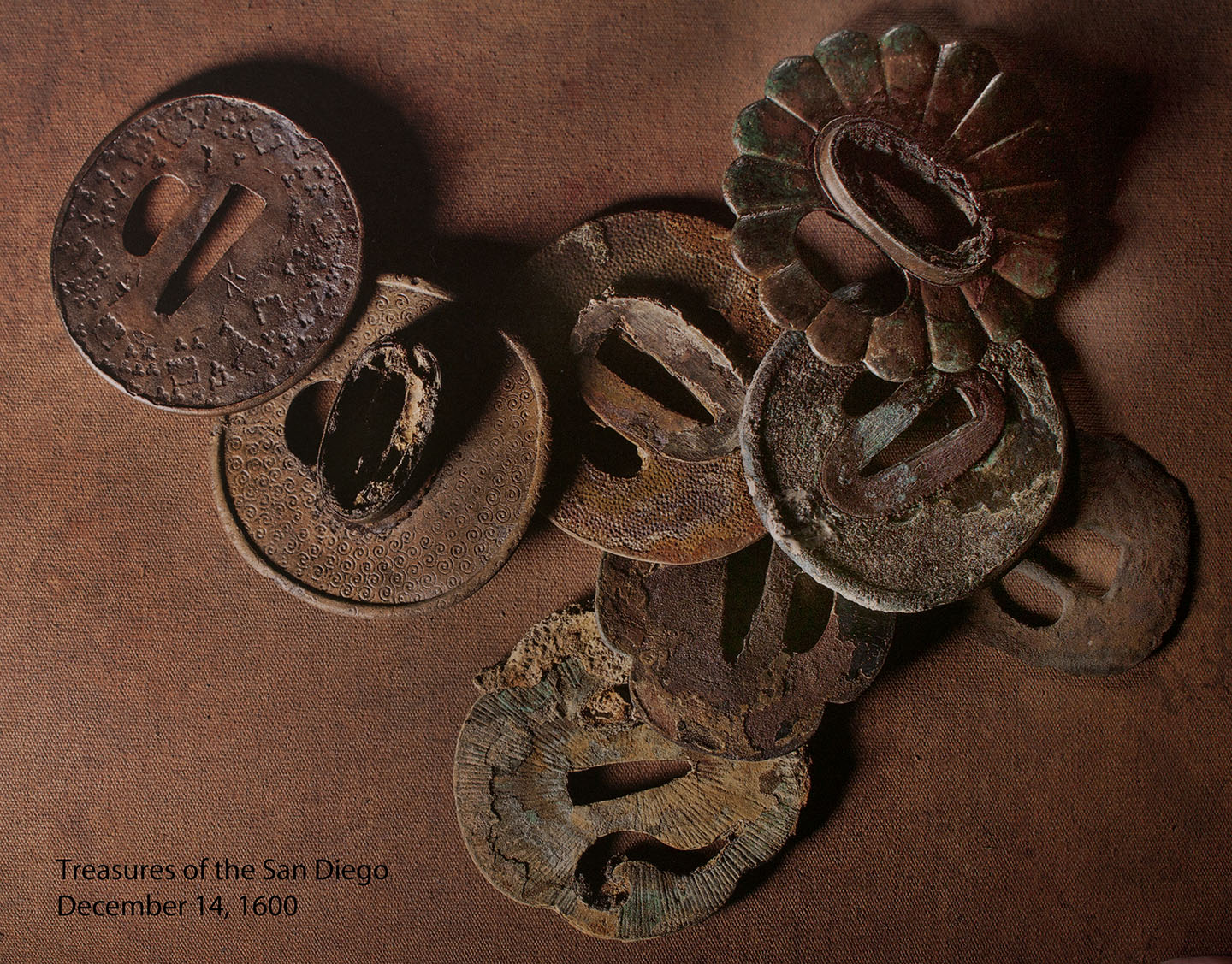
At sword shows I’ve seen the occasional puzzled expression at the use of the phrase San Diegotsuba in conversation. It’s a shorthand used by a few for the types of guards seen in an interesting group found at the bottom of the ocean.
The three guards from upper left to center bottom measure 6.5 cm H x 0.2 cm T, 7.0 x 0.25 and 7.3 x 0.25
The Spanish galleon San Diego was sunk just before 3:00 in the afternoon of Thursday December 14, 1600 off the coast of the Phillipines. The wreck was discovered in 1991 and over the course of two field seasons 5,262 objects were recovered.
“Undoubtedly, more than four hundred men crowded the decks – Spanish sailors, natives and even Japanese mercenaries whose presence is attested by their weapons and personal belongings. Twelve hundred pieces of blue-and-white porcelain have been recovered, indicating that the vessel was carrying a rich cargo of china tableware.” (Treasures of the San Diego, c 1996, Association Francaise d’Action Paris, Fondation Elf Paris and Elf Aquitaine International Foundation, New York)
I have an English language copy of Treasures, but if you happen to look for one note that most copies around are in Portuguese. It’s a great book covering the history of the period, details of the ship, its sinking and the European and Asian artifacts recovered. There is a section covering weapons including articles on small arms, artillery and one titled Japanese Warriors by Catherine Delacour. She gives an overview of Japanese history and activity in the region in the 16th C and in the Philippines in particular. Near the end of that century there were around 1,500 Japanese living in Manila including bushi working for Spain, some of whom shipped out on the San Diego and left behind various personal effects when it went down.
No iron artifacts survived submersion, but the group of copper alloy tsuba pictured above were recovered from the wreck. Two of these have fuchi and seppa stuck in place with corrosion and two have just seppa. We find guards like these in circulation today. They’re relatively small with simple but varied decorations. Given that they only have kozuka ana they were probably mounted on wakizashi. It’s interesting that the kiku-gata tsuba has an opening large enough for an o-kozuka. I don’t see any mention of kozuka or kashira being recovered from the wreck. Metal (or any) kashira may not have been used.
So while none of these tsuba have dates, we do know that they weren’t made after 1600, a useful data point. Whether these guards were all brought from home or some made outside of Japan would be interesting to know.
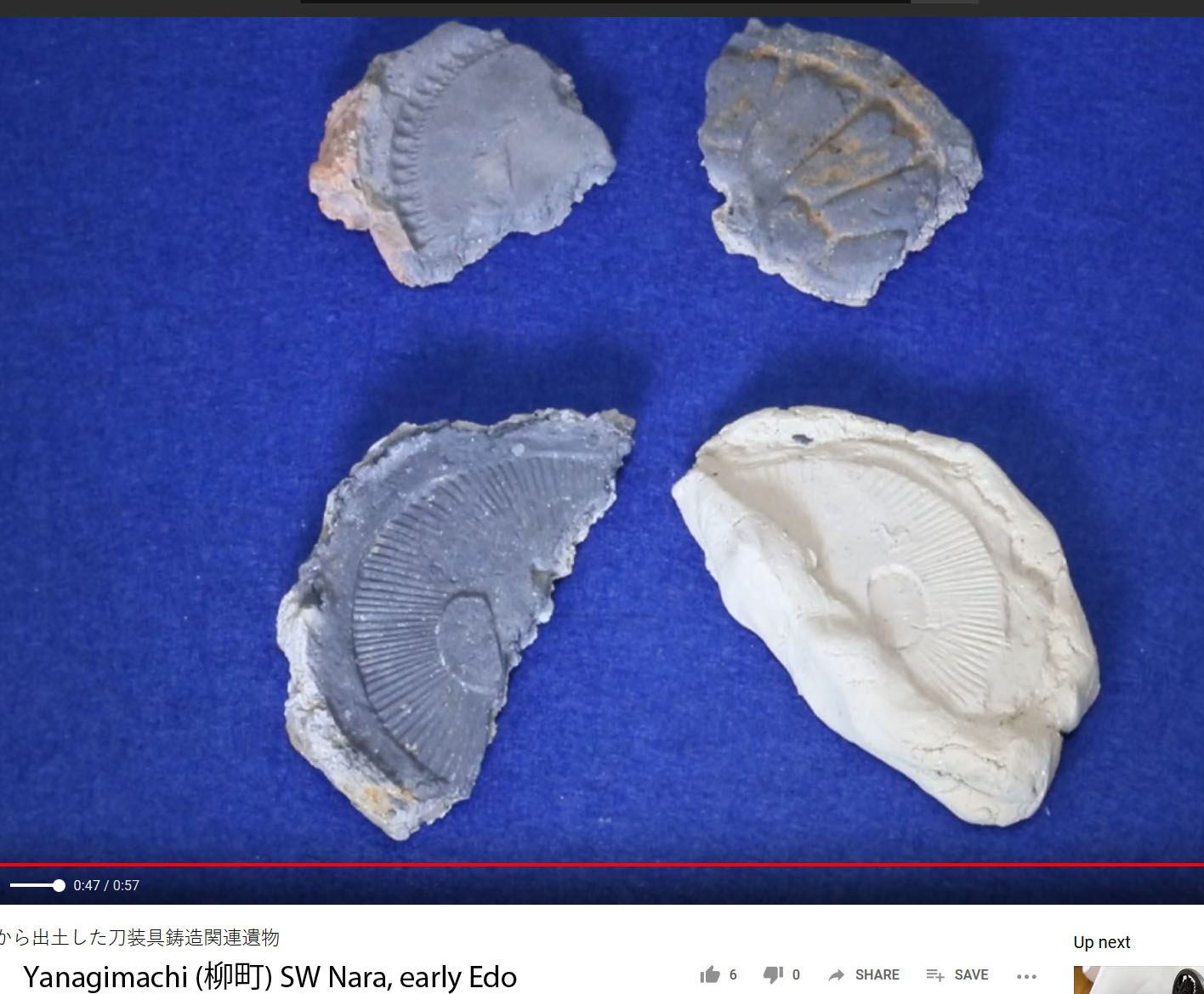
Update: Excavation of an early Edo period archaeological site in Nara yielded casting crucibles and molds including some that would have produced tsuba very similar to the above.
a still captured from the Sankei News video
Note that the lower right object is a clay impression taken from the mold to its left. The video is below:
Thanks to Markus Seksko for his blog post from a few years ago. More detail can be found here:
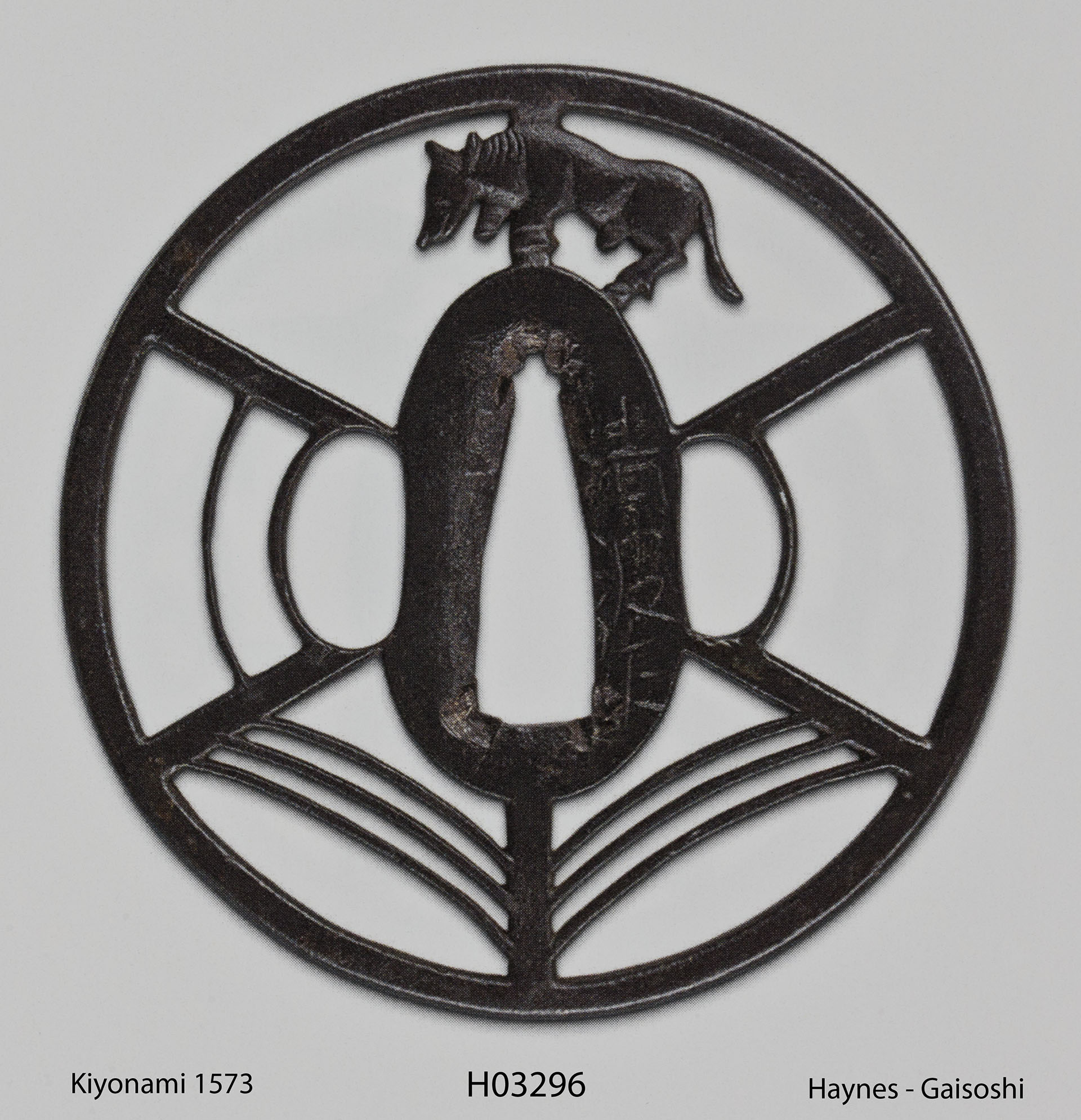
I recently came across an iron sukashi tsuba dated Tensho 3 that got me thinking again about the question of whether these early dated guards are legitimate or some sort of tribute (at best). The first of these I saw 20 plus years ago was one Robert Haynes had turned up that appeared in the famous Red Cross catalog. It’s illustrated in his book Study Collection of Japanese Sword Fittings – Gai So Shi.
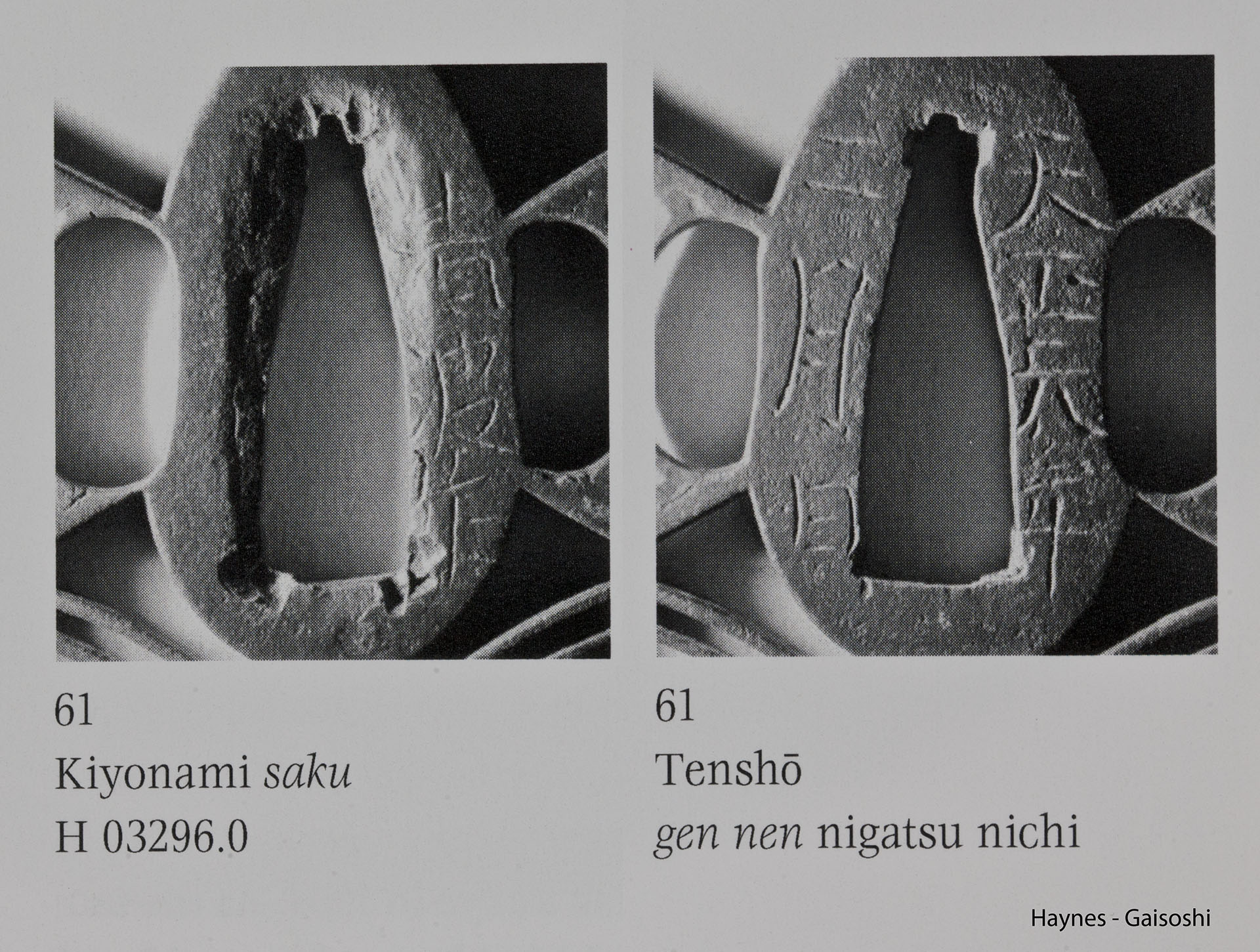
Bob writes “Since it is the only known example of this signature I entered it in my book as H 03296.0. In Japan such dates are dismissed, but they are wrong. There are a large number of dated tsuba before and just after this one, such as 1532, 1543, 1573, 1582, 1587 and another dated the same year as this one.” Closer views of the signature are here:
February 1573
The light is hitting the strokes a bit differently on the two sides, but the style of the characters look consistent. If adding a spurious early date, why do so with an otherwise unknown name? The workmanship of the rest of the guard is consistent with the period. I’m inclined to agree that it’s more likely genuine than not.
I undertook a search of Haynes’ opus mentioned in his quote above, The Index of Japanese Sword Fittings and Associated Artists for these other dates. I wound up expanding the search through all dates from the 16th century and came up with the following list.
1502 Ranko (Owari) H 07516
1504 Myochin Nobutada H 07188
1523 Miko (Hizen) H 05085
1532 Myochin Yoshifusa H 11476
1532 Muneoku H 06209
1533 Tadamasa (Hizen) H 09102
1533 Terutoshi (Mutsu) H 09651
1538 Myochin Munenori H 06194
1558 Myochin Unkai H 11064
1563 Munenaga H 06172
1570 Shoami Iranken H 01899
1573 Kiyonami H 03296
1573 Masahige (Heianjo) H 04472
1575, 77 Koike Masaie (Echizen) H 04047
1577, 78 Suzuki Shigemitsu (Heianjo) H 08352
1577 Suzuki Shigeyuki (Heianjo) H 08609
1577 Kishiwada Zaisai (Izumi) H 12517
1582 Tojo (Kyoto) H 09720
1587 Mori Soemon H 08877
1591 Mitsumoto H 05282
1599 Shoami Tsuneyoshi (Yamashiro) H 10942
Given that the Myochin appear to have extensively embellished their early genealogy I tend to discount the value of those dates listed above. Some may be valid, but setting them aside still leaves us with 19 tsuba with dates from the 1500’s.
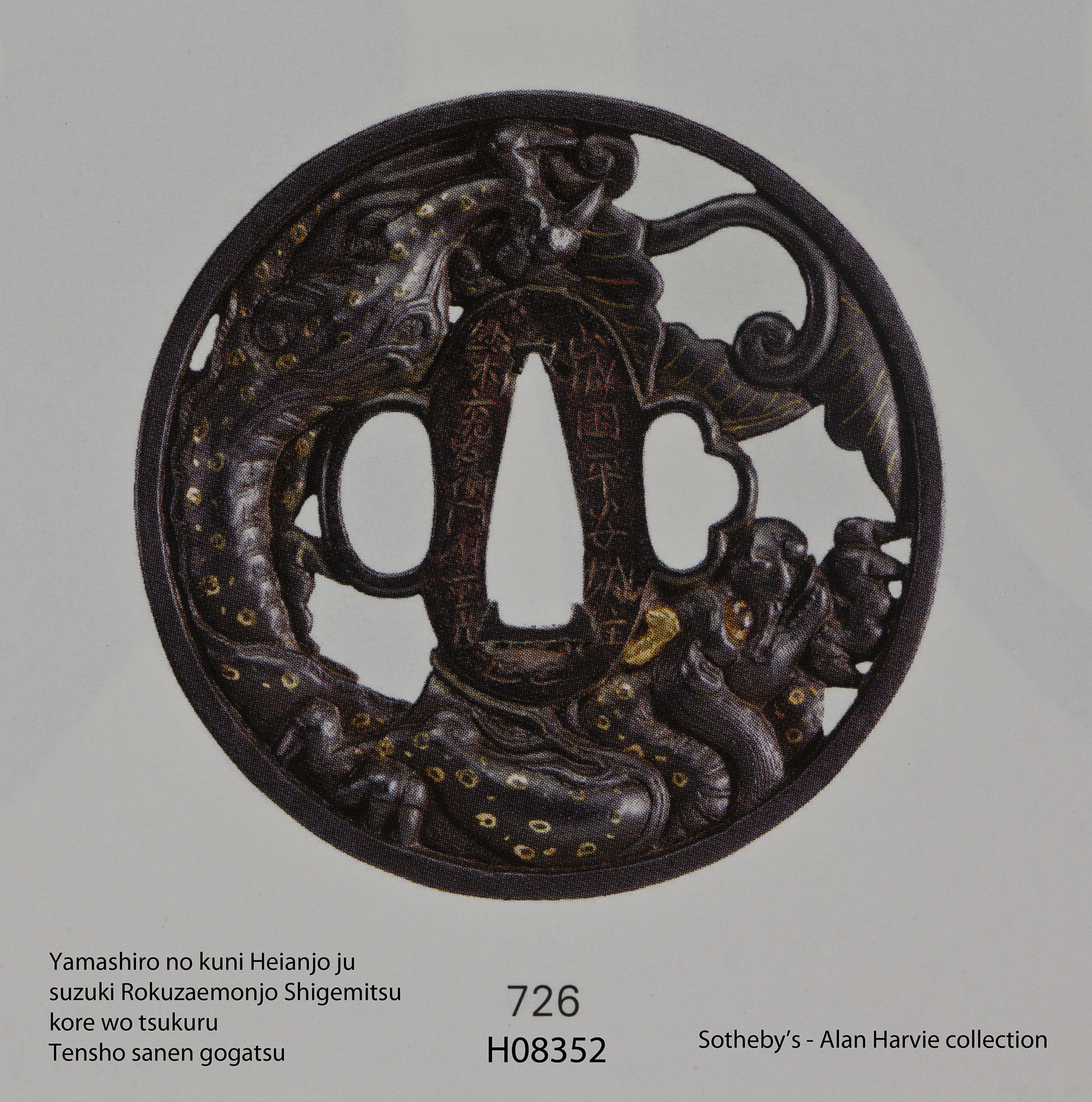
Another Tensho dated example I’ve seen in person was from Alan Harvie’s collection, the illustration here from the 2005 London sale catalog.
Tensho 3 – 1575 8.2 cm H
Unfortunately I don’t have a photo of the other side. This would be the Shigemitsu listed as H 08352 with recorded dates of 1577 and 1578. Since Bob was certainly familiar with this tsuba, there appears to be a slight discrepancy in the record. This is a very finely made and unusual tsuba with the dragon’s eye done in glass. I wish I could get another look at it now. Is it a later worker enhancing his pedigree or an exceptional work? According to the listing there is at least one other dated example by him out there.
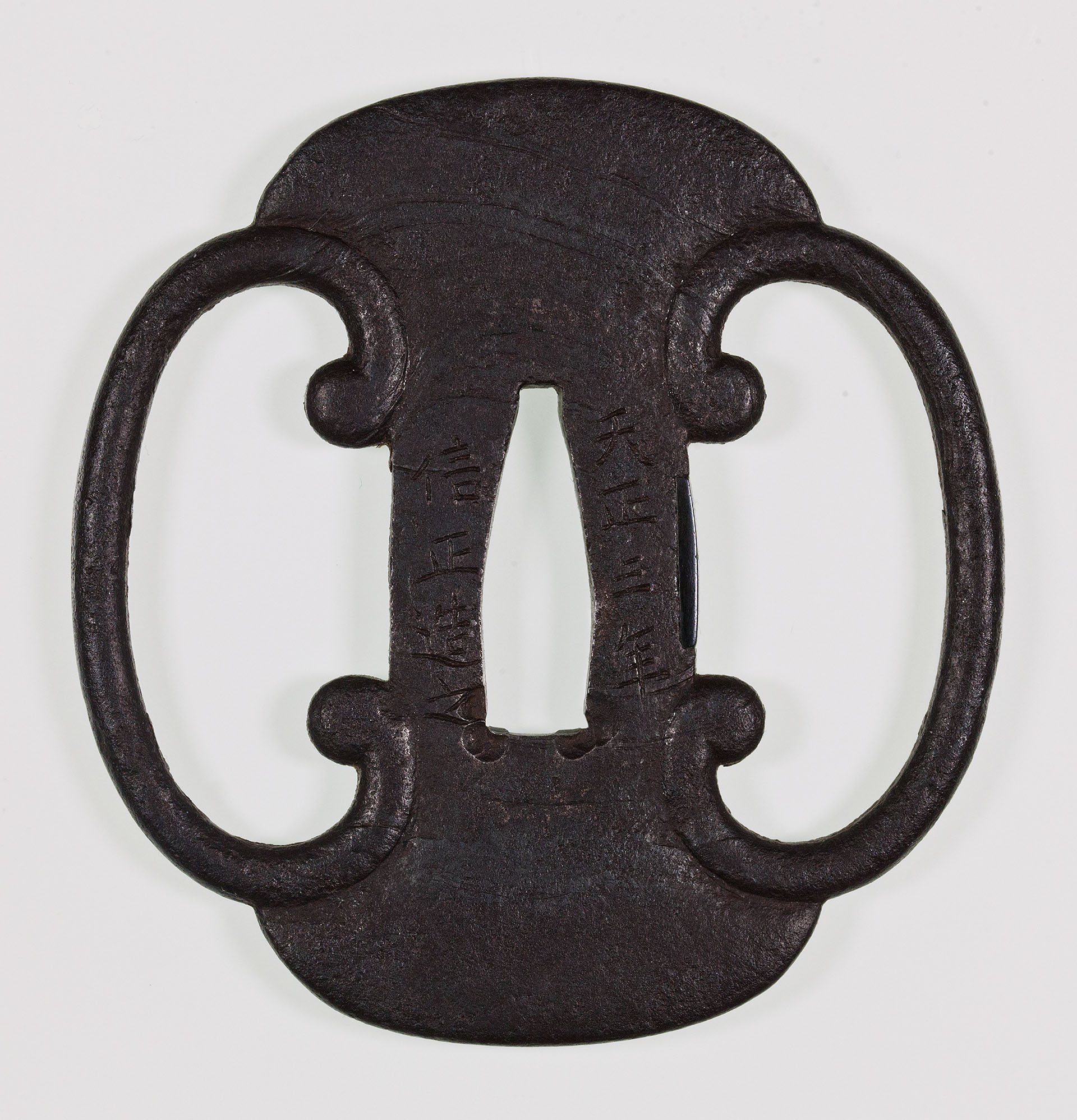
Below is the guard I just found.
7.76 cm H x 0.48 cm TNobumasa kore o tsukuru / Tensho san nen
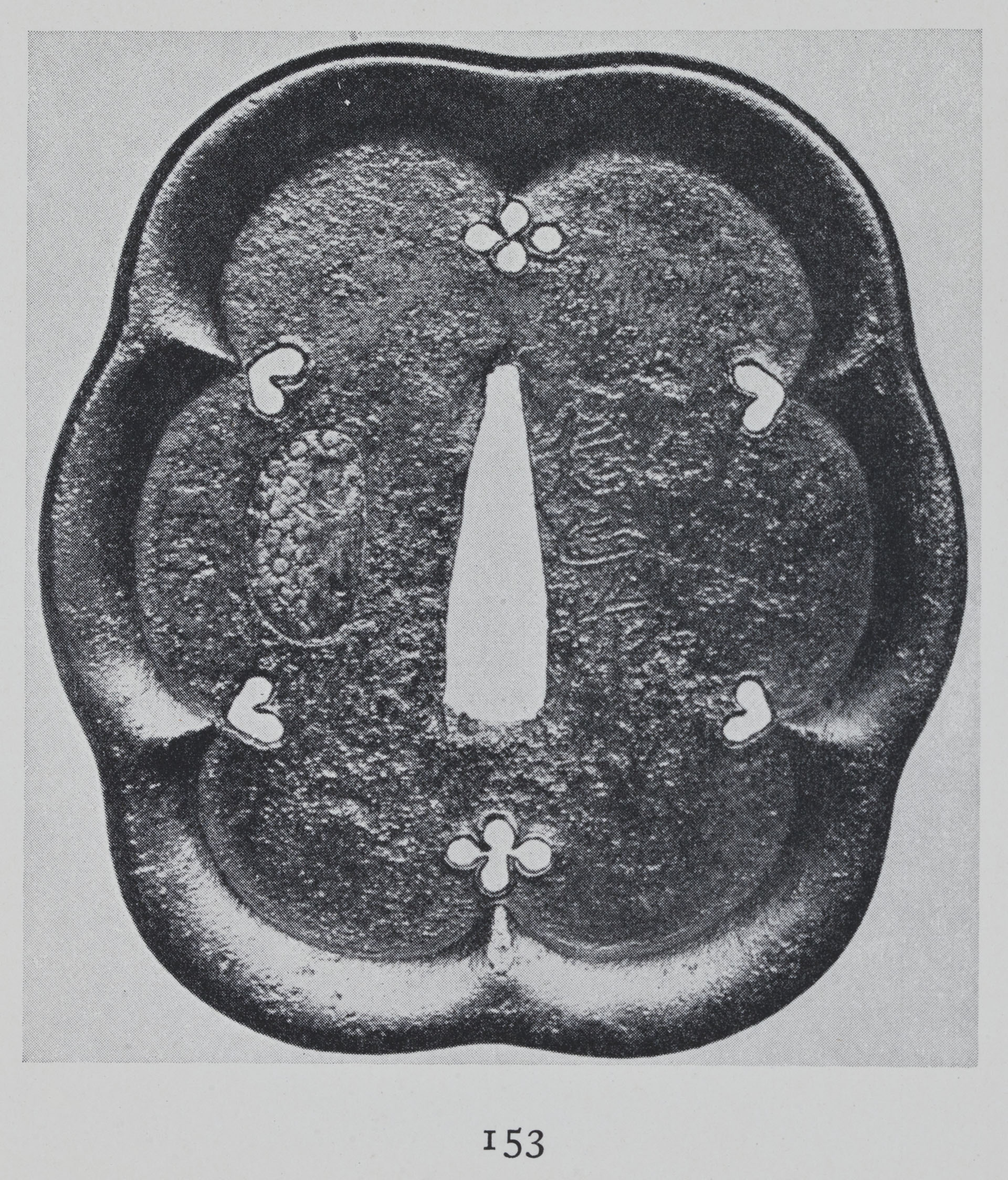
So another date of 1575. Checking Haynes, there is a Myochin Nobumasa with a different masa working ca. 1550-1600, H 07118 but no other information. H 07112 with the same characters and also working 1550 -1600 seemed promising, however the example referenced from the Oeder catalog, p. 20 #153 looks quite different. The signature is not easy to see, but certainly not related.
Oeder collection Nobumasa
If my tsuba was signed with the Myochin family name, I’d expect it to likely be spurious. But this is another case of an otherwise unrecorded artist and a date that appears to be in the same hand as the name. I don’t think of mokume tsuba at this early date, but the rest of the workmanship and condition is not out of line with the period.
It still doesn’t quite ring true to me, but what was the goal if it isn’t? Maybe in the shinshinto revival period there was a market for fake early dates as there was for copies of Nobuie, Hoan, Yamakichi, etc. Of course those are all famous names and unmistakable styles. Why bother with a guard like this one.
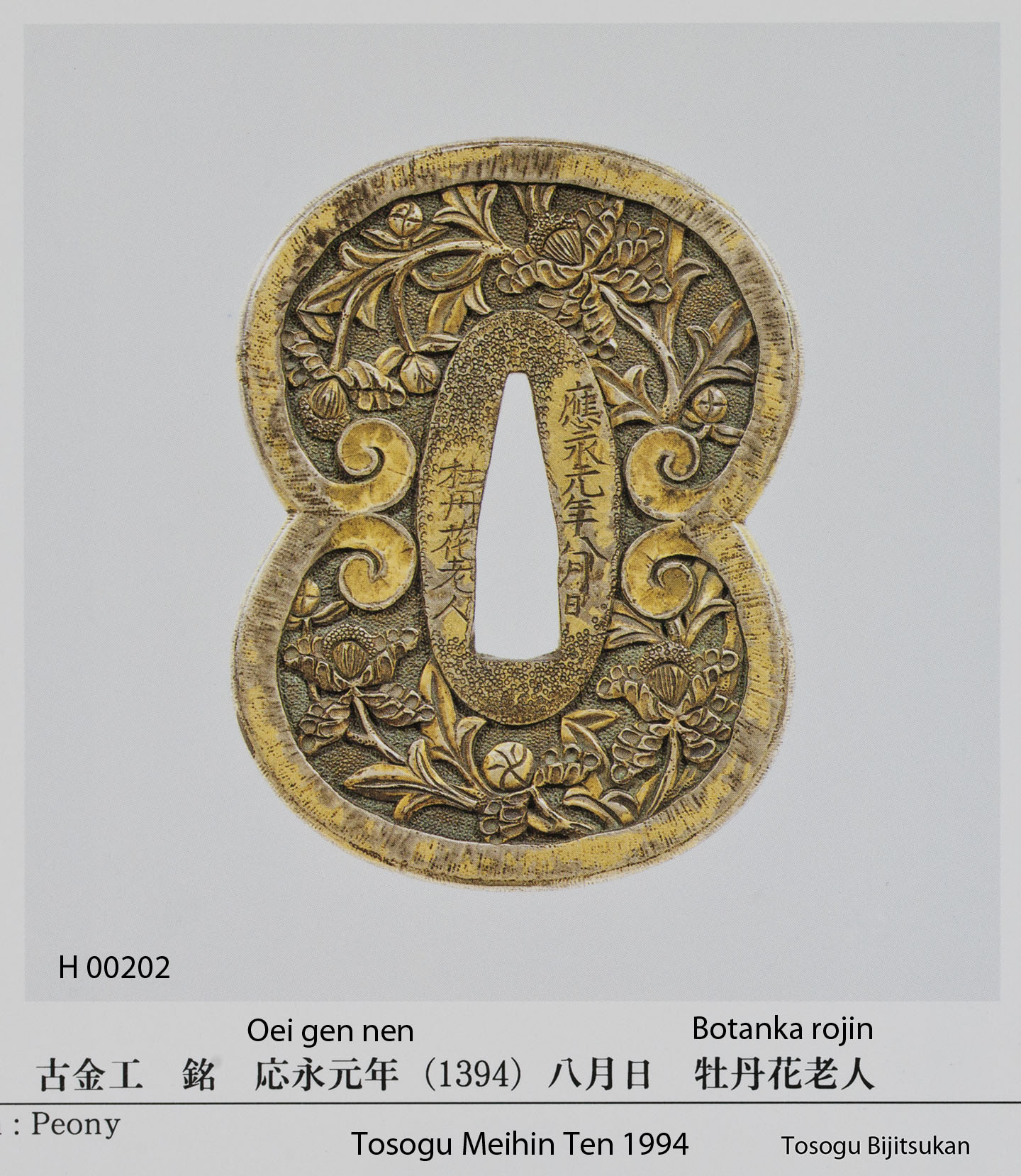
Well outside the date range I covered above is a never the less interesting ko-kinko guard published in one of the great catalogs from the fittings museum in Sugamo back in 1994: (note that in my research files I routinely add random text notes that do not appear in the original photos)
This is dated much earlier, 1394, and enigmatically signed Botanka rojin. Haynes lists this guard at H 00202 and interprets the signature as perhaps “old Mr. Peony Flower” (botan being peony). The guard certainly looks like it could be from the period and it’s published in that issue of Tosogu Meihin Ten along with other famous ko-kinko and ko-mino works.
In this case the date looks to me to be cut with a thicker chisel. Is it a different hand? There appear to be a couple of uncertain strokes there. Is it all a tribute of some sort? The ring-type nanako punches on the seppa dai are interesting. They aren’t quite the same as what’s on the web of the guard. Was it added as “proof” that the date couldn’t have been added after the name?
I’m afraid I’ve added confusion on top of uncertainty in this post. If anyone has any other examples or clarifying ideas I’d love to hear your comments.














 Tsuba Kansho